
Opinion
The Fish That Breaks Into Another Animal’s Body to Live, And Sometimes Eats It From the Inside

_By Sam Agogo_
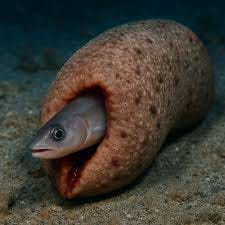
Beneath the warm, shallow waters of the world’s tropical seas lives one of nature’s strangest arrangements: a slender, silvery fish that spends much of its life inside the body of another animal.
This is the pearlfish, a creature so unusual that marine biologists have studied it for well over a century, and one whose habits still provoke wonder among divers, scientists and ordinary readers alike.
Pearlfish belong to the family Carapidae, a group of about 30-odd species spread across the Atlantic, Indian and Pacific Oceans, as well as the Mediterranean. They are long, narrow and almost transparent, with tapering, eel-like bodies that rarely grow beyond 30 centimetres, and most are considerably smaller. They lack scales and pelvic fins, and their bodies taper to a fine point at the tail.

Their ghostly, shimmering appearance is the likely source of the name, since the skin catches light with a pearly sheen.
What makes the pearlfish remarkable is where it chooses to live. Many species shelter inside living marine invertebrates, including sea cucumbers, sea stars, bivalves such as oysters and clams, and sea squirts. Biologists call this lifestyle commensalism, in which one animal benefits from a relationship while the other is, at least in theory, little affected.
The pearlfish gets a safe home, protection from predators in an ocean where a small, soft-bodied fish is easy prey. The host supposedly gets nothing in return.

The way the fish enters its host is both clever and, to human eyes, rather startling. Pearlfish are mostly active at night, venturing out of their hiding places to hunt small crustaceans and other tiny creatures. When daylight returns, the fish searches for a host.
Upon finding a sea cucumber, it locates the animal’s anus, which the sea cucumber uses to breathe by pumping water in and out. The pearlfish noses at this opening, and in many species it pushes its tail in first, reversing into the host’s body cavity until it is fully inside.
Some species enter head first, using a specially adapted pointed snout. Once inside, the fish rests in the respiratory tree of the sea cucumber, where it is protected from larger predators.
The relationship is not always harmless. Some pearlfish species are known to feed on the internal organs of their hosts, particularly the gonads of sea cucumbers. Others have been observed nibbling at the tissue of the animals that shelter them.
In such cases, the relationship moves from commensalism to parasitism. Scientists have also recorded cases where a single sea cucumber hosts more than one pearlfish at a time, sometimes a mated pair, and in some instances several individuals, though how crowded a host can become without suffering serious harm is still a subject of study.
The name “pearlfish” has a second, older meaning that is tied to oysters. Some species are found living within oysters and other pearl-bearing molluscs. Observers over the centuries noted that dead pearlfish were occasionally found encased in the pearly nacre of an oyster, a discovery that fed folklore about pearls being formed around a fish. Scientists generally explain real pearls as the result of an irritant, such as a parasite or foreign particle, being coated by layers of nacre, but the unusual finding of fish entombed in mother-of-pearl has long added to the mystique of the animal.
The life cycle of the pearlfish is as peculiar as its habits. Adults breed in open water, and the fertilised eggs are released in a floating, gelatinous mass. The young hatch into a drifting larval stage that looks nothing like the adult. This larva, known as a vexillifer, carries a long, banner-like filament that extends from the front of its body and is believed to help it stay afloat and avoid detection.
After a period of drifting in the plankton, the larva undergoes a dramatic transformation, shrinking in length and changing shape into a form known as a tenuis.
It is at this stage that the young fish settles down and begins its search for a suitable host to enter.
Pearlfish are also notable for their sounds. Researchers have found that the fish can produce noises by vibrating muscles attached to the swim bladder, effectively drumming from within the confines of their hosts. This ability, found in only some species, is thought to be used for communication, particularly in territorial or breeding contexts. Their skeletons contain features that also set them apart, with unusual arrangements of bones in the head that allow the fish to squeeze through very narrow openings.
Within the larger family there is wide variety. Some species, in the genus Carapus, are strongly associated with sea cucumbers. Others, such as those in the genus Onuxodon, favour bivalve molluscs.
A few species, notably some in the genus Echiodon, have been recorded in association with sea stars or other animals. Not all pearlfish are permanent residents of their hosts. Some leave at night to feed and return by morning, while others remain inside for long stretches, emerging only occasionally.
For people living near the coast, pearlfish are of little commercial importance. They are not widely fished for food, and their small size makes them unattractive to most fishing operations. Their principal value lies in science and conservation. By studying relationships such as these, marine biologists gain a better understanding of how species depend on one another in coral reefs, seagrass beds and sandy sea floors. The health of a pearlfish population is closely linked to the health of its hosts, and sea cucumbers in particular are under pressure in many parts of the world because of overharvesting for the Asian food and traditional medicine markets.
A decline in sea cucumbers can therefore have knock-on effects for the creatures that depend on them, pearlfish included.
Hobbyists also sometimes encounter the term “pearl fish” in a different setting. Aquarium keepers use it informally for certain freshwater species with a pearl-like sheen or spotted pattern, such as the pearl gourami and some pearl danios. These are unrelated to the marine pearlfish and are bred in captivity for ornamental use.
The distinction is worth noting, for the true pearlfish of the Carapidae family is a wild, ocean-dwelling animal that is rarely, if ever, kept successfully outside the sea.
In the end, the pearlfish tells a larger story about the ocean and about nature’s capacity for improvisation.
In a world where survival often depends on strength, speed or size, this small, translucent fish has built its existence on stealth, adaptation and the borrowed shelter of another creature. It is a reminder that life beneath the waves is far more inventive, and far more interconnected, than the surface suggests.
For comments, reflections and further conversation
Email: samuelagogo4one@yahoo.com
Phone: +2348055847364