Opinion
Orji Kalu: Nigeria’s Economic Challenges Go Beyond Corruption, Reflect Decades of Poor Decisions

:
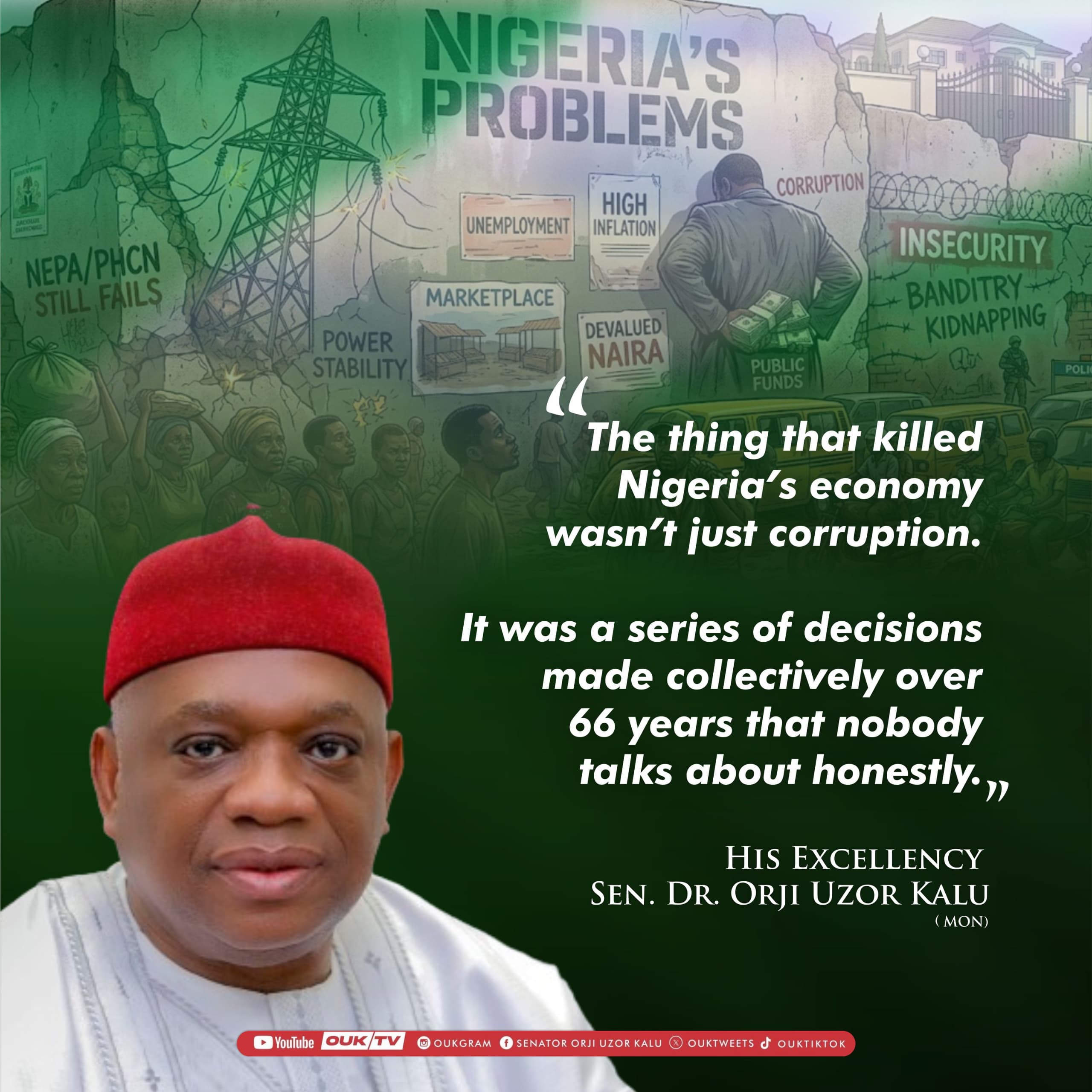
Senator Dr. Orji Uzor Kalu (MON) has said that corruption alone cannot be blamed for Nigeria’s economic difficulties, arguing that the nation’s current challenges are the result of a series of decisions made collectively over the past 66 years.
According to him, while corruption has undoubtedly contributed to Nigeria’s economic problems, it represents only a portion of a much broader issue. He noted that years of policy choices, missed opportunities, weak institutions, inadequate planning, and a failure to prioritize long-term national development have significantly shaped the country’s economic reality.
Kalu observed that Nigeria gradually became overly dependent on oil revenue while paying insufficient attention to key sectors such as agriculture, manufacturing, technology, and industrial production. Rather than developing a diversified economy capable of withstanding global economic shocks, the country relied heavily on a single source of income. As a result, the vulnerabilities of the economy became evident whenever oil prices declined.
He further stated that successive governments, political leaders, institutions, and citizens have all played roles in shaping the economic conditions the nation faces today. He identified poor investment in education, inadequate infrastructure, inconsistent economic policies, weak support for local industries, excessive dependence on imports, and a culture that favors consumption over production as major contributing factors.
The former governor also pointed out that several important issues are rarely discussed openly. These include how policy inconsistency discourages investment, how poor maintenance culture leads to the waste of public resources, and how ethnic and political considerations often take precedence over competence and the national interest.
According to Kalu, these challenges have accumulated over many decades and cannot be resolved overnight. He stressed that economies are either built or weakened by decisions made consistently over time.
He maintained that Nigeria’s present economic situation is not the result of a single administration, generation, or isolated mistake. Rather, it is the outcome of countless decisions taken over many years, some of which were influenced by personal interests instead of national priorities.
Kalu emphasized that acknowledging this reality should not be viewed as an attempt to assign blame, but as an opportunity to learn from past mistakes and make better choices for the future. He noted that economic transformation requires honesty, accountability, strategic planning, and a commitment to policies that encourage productivity, innovation, and sustainable growth.
Despite the challenges, he expressed optimism about Nigeria’s future, describing the country as richly blessed with both human and natural resources. He said the same collective effort that contributed to past mistakes can be harnessed to build a better future.
He concluded that the first step toward meaningful progress is engaging in honest conversations about the decisions that have shaped the country’s current situation and identifying the actions necessary to move Nigeria forward.
#OUK