
Opinion
Catholic Bishops Confront Tinubu Over State of the Nation, Cardinal Onaiyekan Says Concerns Were Rejected

_By Sam Agogo_
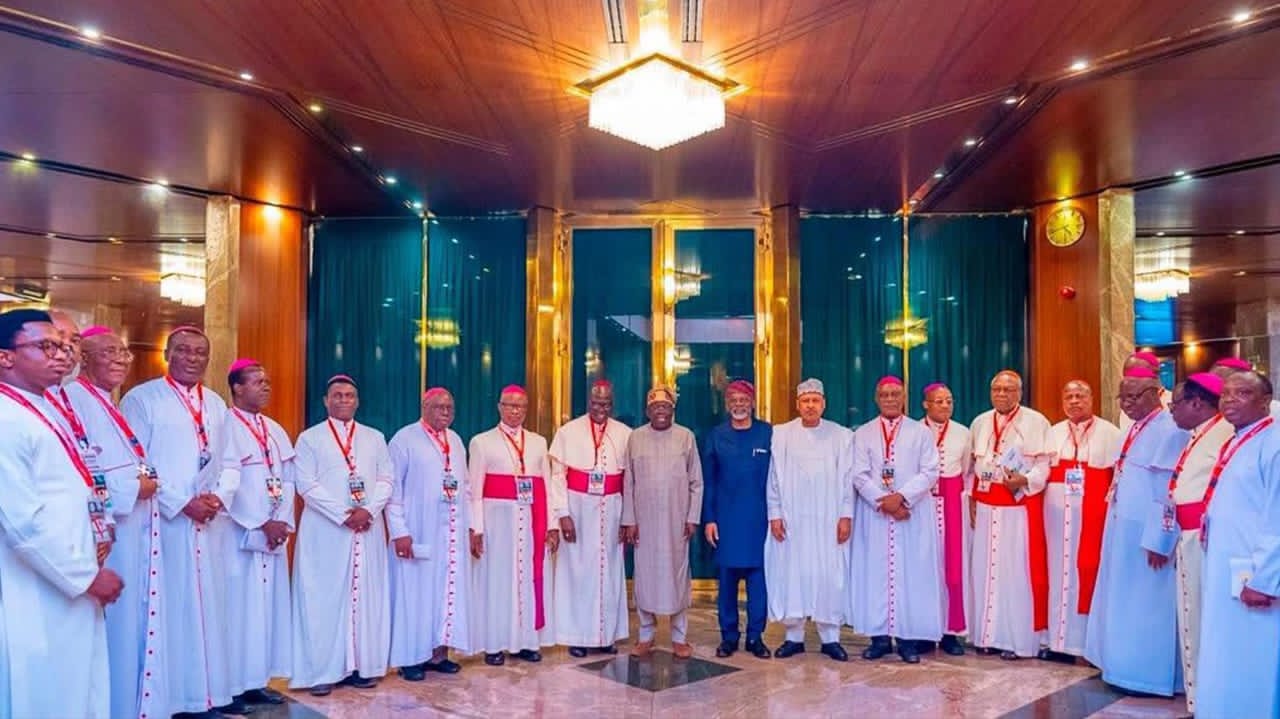
A courtesy visit is rarely expected to make news. It is, by design, a formality: a delegation calls on a head of state, offers pleasantries, poses for photographs, and departs. When the leadership of the Catholic Bishops’ Conference of Nigeria, CBCN, led by Archbishop Matthew Man-Oso Ndagoso of Kaduna, called on President Bola Ahmed Tinubu at the State House, Abuja, it was billed as exactly that. It did not remain that. What transpired inside that meeting, and what has followed in its aftermath, has become one of the more consequential exchanges between Church and State in recent Nigerian memory, and a revealing test of how this administration receives criticism it did not solicit.
The nineteen-member delegation did not travel to Aso Rock to offer tribute. They came with a documented account of the nation’s condition: insecurity that has turned schools, churches, farms and highways into sites of recurring violence; an economy in which the benefits of reform have yet to reach the majority of citizens, even as inflation persists and infrastructure continues to deteriorate; a political environment growing narrower ahead of the 2027 general elections; and unresolved anxieties among Christians over the protection of their constitutional rights. Archbishop Ndagoso described the encounter as one between “partners in building a just, peaceful and prosperous Nigeria.” The president’s response suggests he did not regard the exchange in those terms.
In reply, President Tinubu asserted that the Independent National Electoral Commission remains neutral, that the economy is performing well, and that Nigeria’s security architecture is being repositioned to deliver decisive victories against terrorism, banditry and kidnapping. It was the language of an administration defending its record, not one weighing counsel from a body that had come prepared with a starkly different account, drawn from parishes, markets and displaced communities across the country.
Cardinal John Onaiyekan, Archbishop Emeritus of Abuja, made the outcome of that meeting public. In a televised interview days later, he stated that President Tinubu had rejected the bishops’ concerns outright, and that neither the president nor the aides present appeared pleased by what they heard. “Nigeria is bleeding,” the Cardinal said. He added that the bishops’ account diverged sharply from the reassurances the president routinely receives from those closest to him, a discrepancy he described as one of the more troubling features of the current political environment.
That a sitting president, presented with a sober and documented account of national suffering by the leadership of one of Nigeria’s most influential religious institutions, would respond with defensive assertions rather than engagement is itself the substance of this story. It was not the register a head of state should adopt in addressing men who had come bearing the testimony of the poor, the displaced, and the grieving. The presidency’s subsequent response, characterising Cardinal Onaiyekan’s disclosure as a breach of confidentiality and an overreach of clerical privilege, has reinforced the perception of a government more concerned with controlling the narrative than confronting its content. Fairness requires acknowledging the presidency’s position: that the president operates with intelligence and security briefings unavailable to the public, and that his account of the nation’s trajectory is entitled to be heard and weighed on its own terms. But the instinct to discredit the messenger rather than answer the substance of the message is a familiar pattern in Nigerian governance, and one that has rarely served the public interest.
This episode does not stand alone. It is the latest expression of a position the Catholic Bishops’ Conference has stated formally and repeatedly through its plenary communiqués. At its First Plenary Meeting in February 2026, convened in Abuja under the theme “Leadership for the Common Good,” the CBCN identified poor leadership and a distorted conception of politics as a principal cause of the nation’s afflictions, one in which political office has been treated as a vehicle for illicit enrichment. The bishops drew a direct connection between that failure of leadership and the deterioration of the economy, the persistence of insecurity, and the depth of poverty in a country otherwise endowed with substantial human and natural resources, along with the corruption, infrastructural decay, unemployment and erosion of institutional trust that have accompanied it.
That statement extended a position the Conference had articulated the year before. At its 2025 plenary in Ikot Ekpene, the bishops again named corruption and bad governance as the fundamental cause of the country’s difficulties, and renewed their call for credible electoral reform, including transparent electronic transmission of results and impartial appointment of INEC officials. Months earlier, opening that year’s plenary session in Abuja, then CBCN President Archbishop Lucius Ugorji had already stated that the Church must consistently stand against bad governance and demand transparency from those in power. The Conference’s 2021 communiqué, issued in Enugu, traced the agitations for self-determination then unsettling the country to bad governance, injustice, and inequity in the distribution of resources and appointments, a diagnosis that has proven durable.
Taken together, this record establishes a consistent institutional position rather than an isolated statement. Across successive plenaries, under different Conference presidents, addressing different administrations, the CBCN has arrived repeatedly at the same conclusion: that Nigeria’s difficulties originate substantially in the quality of its leadership, and that naming this plainly is a responsibility the Church cannot set aside.
Cardinal Onaiyekan’s own record extends this institutional position into more than four decades of individual public witness. He has described Nigeria’s democracy as moving backward. He has characterised the country’s politics as a contest for control of resources, in which officeholders who once lived modestly acquire sudden and unexplained wealth while the majority grows poorer. He has rejected, directly, the claims of leaders who deny that Nigeria has experienced bad governance, stating that they understand the reality as well as anyone. He has spoken of a “silent violence of poverty” affecting families who cannot feed themselves and communities displaced by insecurity, and warned that continued disregard for the frustrations of unemployed youth carries the risk of unrest that leadership may struggle to contain. On the occasion of Nigeria’s sixty-fifth independence anniversary, he stated that the nation’s failure to fulfil the promise of 1960 was attributable not to a shortage of resources, but to decades of mismanagement and corruption.
What distinguishes this particular engagement is the contrast it draws with the pattern of deference that typically characterises visits to the State House. Nigeria’s leadership rarely wants for delegations prepared to offer commendation. Traditional rulers, professional bodies, religious groups and political associations regularly present themselves at Aso Rock with tributes to a record that, outside those walls, tells a different story. This has become a familiar sequence: courteous visits, favourable photographs, and reassurance offered to a leadership already inclined to receive it.
The Catholic bishops departed from that sequence. They did not attend to affirm; they attended to inform, and to do so honestly, regardless of how the message would be received. That distinction matters in a political culture in which access to power is frequently conditioned on flattery. Whatever discomfort the meeting produced was a discomfort the country required someone to introduce. Had more of Nigeria’s institutional visitors approached engagements with the presidency in the same spirit, the country’s leadership might operate with a more accurate understanding of the conditions it governs.
This consistency, evident both in the Conference’s formal communiqués and in Cardinal Onaiyekan’s individual record, sets a standard the wider community of Nigerian religious leaders would do well to match. Too many pulpits, across denominations, have settled into a posture of proximity to power rather than accountability toward it, offering prayers for leadership without corresponding demands for performance. The Catholic hierarchy’s willingness to absorb political criticism in exchange for stating the truth plainly demonstrates that religious authority and public accountability are not in tension.
Other clerics, Christian and Muslim alike, would serve their congregations and their country by adopting the same standard. Religious leaders across Nigeria command audiences considerably larger than any single diocese, and their collective moral authority, if directed consistently toward the conduct of governance rather than reserved for matters of personal piety and prosperity, would represent a significant check on the conduct of those in power. Nigeria is not short of religious leadership. It is short of religious leadership prepared to speak to power as directly and consistently as the Catholic bishops have just done.
Nigeria is bleeding, as the Cardinal stated. That condition will not resolve itself through denial from those in authority. It will begin to improve only when a broader range of voices, religious and civic, decline the comforting narrative and insist, consistently, on an accurate account of the nation’s condition.

*For comments, reflections and further conversation, reach me at samuelagogo4one@yahoo.com, +2348055847364*