
General News
Night Coup Plan: Colonel Ma’aji Opens Up on Alleged Tinubu Plot

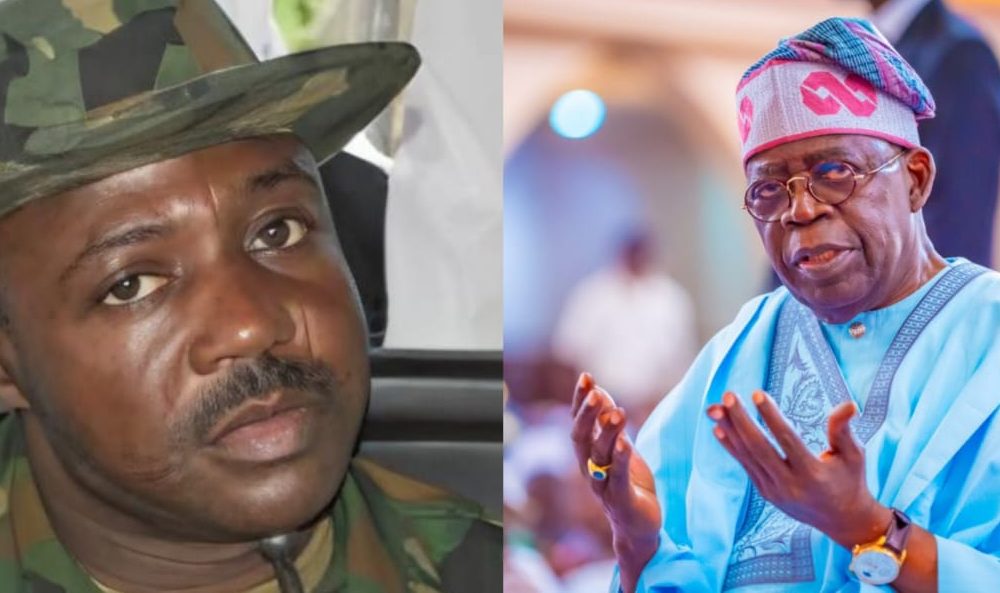
Fresh court records have revealed new details about how military officers and civilians allegedly developed, suspended and later revived a plan to overthrow President Bola Ahmed Tinubu’s administration.
The documents, running into thousands of pages, contain bank records, hotel receipts, electronic communications, interrogation materials and other evidence gathered during investigations into the alleged plot.
At the centre of the investigation is Colonel Mohammed Ma’aji, whom military investigators identified as a key figure in the alleged conspiracy. Ma’aji and other serving military officers are facing proceedings before a General Court Martial, while six retired military personnel and civilians are standing trial separately before the Federal High Court in Abuja.
All the defendants have denied wrongdoing, while the allegations remain subject to judicial determination.
How the alleged plan began
According to an extrajudicial statement attributed to Ma’aji and contained in the investigative records, discussions about military intervention began in 2023, towards the end of former President Muhammadu Buhari’s administration.
Ma’aji told investigators that insecurity, corruption, economic hardship and what he considered poor governance were among the issues that fuelled discussions among some officers.
He said officers who shared similar concerns were gradually identified and approached, adding that those involved believed they were motivated by patriotism and a desire for positive change.
However, the alleged plan did not immediately progress due to difficulties with funding, logistics and manpower.
Ma’aji claimed that he personally provided a substantial portion of the money used during the early stages through the sale of some of his personal properties, alongside contributions from other members.
According to his statement, one Army major contributed ₦1 million, while another officer allegedly provided foreign currency on several occasions.
Ma’aji also claimed that he sold three houses in Kaduna State and a student hostel at Ahmadu Bello University, Zaria, to finance activities associated with the group.
Failed promotion and alleged revival
The documents indicate that the alleged plan was later revived after Ma’aji failed for a second time to secure promotion to the rank of brigadier general in 2024.
He said some members subsequently contacted him and called for the movement to be revived.
Ma’aji, however, insisted that his failed promotion was not the main reason for the alleged plot.
He instead cited several economic and political issues, including fuel subsidy removal, naira reforms, taxation, electricity tariffs, corruption and insecurity.
He also referred to the handling of the #EndSARS and #EndBadGovernance protests, arguing that unemployment and economic hardship had left many young Nigerians frustrated.
Meetings in Abuja
Ma’aji told investigators that Lieutenant Colonel Shamsuddeen Bappah was among those who pushed for the alleged plan to be revived.
According to his statement, Bappah travelled from Ibadan to Abuja to persuade him to continue with the project and reportedly offered to sell a plot of land in Bauchi to raise funds. The property was not sold, according to the records.
The alleged conspirators subsequently held meetings at different locations in Abuja.
Ma’aji identified Brookville Hotel and Greenland Hotel in Lokogoma as among the venues where meetings were held.
He said the first of the renewed meetings took place towards the end of 2024 or early 2025, involving some of the officers who had participated in earlier discussions.
New members were allegedly introduced as the group attempted to expand its network.
Plans for manpower and access to the Villa
The statement attributed to Ma’aji also contained claims about efforts to recruit individuals who could provide access, manpower and logistical support.
He said Zekeri Umoru, an electrician at the Presidential Villa, was introduced through Police Inspector Ahmed Ibrahim.
Ma’aji claimed that Umoru initially requested ₦1 billion to facilitate access to the Villa, but that he rejected the demand.
He also described an alleged proposal to mobilise members of the Civilian Joint Task Force in the North-East.
According to Ma’aji, Major Iliyasu suggested using CJTF members as manpower and claimed that the group had access to weapons.
The alleged plan was, however, not fully implemented.
Ma’aji said the team had not been completely formed because further meetings were expected, adding that there was no D-Day as the group was waiting for more resources, officers and soldiers.
What investigators say was planned
The investigative records contain more serious allegations about what the group allegedly intended to do if it secured sufficient manpower and resources.
According to Ma’aji’s statement, some individuals were expected to help secure key locations and detain senior officials.
He said the alleged plan involved arresting service chiefs and that the operation was intended to take place at night.
He explained that the purpose of obtaining photographs and assigning certain tasks was to place the service chiefs under arrest at their homes without interfering with their movement, adding that the alleged coup was planned for the night.
However, he said the operation never reached the stage of execution.
The prosecution has separately alleged that the plotters planned to seize the Presidential Villa and eliminate or capture senior political figures, including President Tinubu, Vice President Kashim Shettima, Senate President Godswill Akpabio and House of Representatives Speaker Tajudeen Abbas.
A prosecution witness later told the Federal High Court that investigators recovered a notebook from Ma’aji’s residence containing alleged operational plans, names of senior officials and proposed political and structural changes following the alleged coup.
The financial trail
Financial transactions have become a major component of the prosecution’s case.
A military police officer who testified before the Federal High Court said investigators found financial links between Ma’aji, former Bayelsa State governor Timipre Sylva and some of the defendants.
The witness said Purple Waves Limited was allegedly used as a channel for moving funds connected with the suspected operation.
He also told the court that investigators identified multiple transactions between September 19 and October 2, 2025, involving hundreds of millions of naira.
The Federal Government’s 13-count charge against six defendants also contains allegations of terrorism financing and money laundering involving various sums of money.
Ma’aji’s account of the money
In his statement, Ma’aji claimed that he personally spent substantial sums on the alleged movement, with some of his contributions coming from the sale of personal property.
He also referred to contributions from other members.
The statement contains a claim that former Bayelsa State governor Timipre Sylva contributed about ₦400 million.
Sylva has denied involvement in the alleged plot.
His spokesperson described him as a committed democrat and said he had no involvement in planning or financing a coup.
Because the allegation remains contested, the reported financial claims against Sylva should not be treated as established fact.
How the alleged plot was uncovered
The alleged plan came under security scrutiny in September 2025.
According to evidence presented in court, an intelligence report concerning Ma’aji and other individuals was received by the then Chief of Army Staff, Olufemi Oluyede.
A prosecution witness said the report was assessed and considered credible before investigators were directed to act.
Investigators subsequently searched Ma’aji’s residence and reportedly recovered a notebook containing what they described as operational plans, names and designations of ranking members of the current administration, as well as officers allegedly assigned to assassinate them.
Investigators also reportedly recovered electronic and documentary evidence which they said linked Ma’aji to other suspects.
The wider investigation eventually resulted in the arrest or questioning of dozens of serving and retired military personnel, police officers and civilians.
Military initially described probe as routine
The alleged plot was initially surrounded by uncertainty.
When reports emerged in October 2025 that military officers were being detained, the Defence Headquarters initially said the officers were undergoing a routine internal investigation aimed at maintaining discipline and professionalism.
The military later acknowledged that an alleged coup plot was under investigation and that those found culpable would face appropriate judicial proceedings.
By January 2026, reports based on security sources had provided more details of the alleged plan, including claims that the plotters intended to overthrow the government and assassinate senior officials.
Court proceedings continue
The Federal Government subsequently filed 13 counts against six defendants at the Federal High Court in Abuja.
The charges include treason, terrorism, failure to disclose information about an alleged coup and money laundering.
The defendants include retired Major-General Mohammed Ibrahim Gana, retired Navy Captain Erasmus Ochegobia Victor, Police Inspector Ahmed Ibrahim, Presidential Villa electrician Zekeri Umoru, Bukar Kashim Goni and Islamic cleric Abdulkadir Sani.
They have all pleaded not guilty.
Meanwhile, serving officers, including Ma’aji, are facing separate proceedings before a General Court Martial.
A major issue in the trials has been the admissibility of statements obtained from suspects during investigations.
Some defendants have challenged the statements, arguing that they were not made voluntarily, while the prosecution has disputed those claims.
The court has therefore ordered trial-within-trial proceedings in cases where the voluntariness of statements is contested.
In May 2026, the Federal High Court heard video recordings in which two defendants were reported to have admitted knowledge of the alleged coup plot.
What the documents establish — and what they do not
The documents provide a detailed account of what investigators say happened and contain statements attributed to Ma’aji describing the alleged development of the plan.
However, the material does not amount to a final judicial finding that a coup was successfully organised or that every person named in the investigation participated in it.
The defendants remain presumed innocent until proven guilty.
The courts will ultimately determine whether the prosecution can establish its allegations beyond the required legal threshold.
For now, the emerging picture from the investigation is of an alleged conspiracy that began with discussions among dissatisfied officers, struggled to secure sufficient resources, was revived after further recruitment and planning, and was eventually disrupted before its alleged operational phase.
The case remains before the courts, where the competing accounts of the prosecution and defendants will continue to be tested.