
Legislature
Senate Moves to Reform Police Funding, Advances Trust Fund Bill for Second Reading

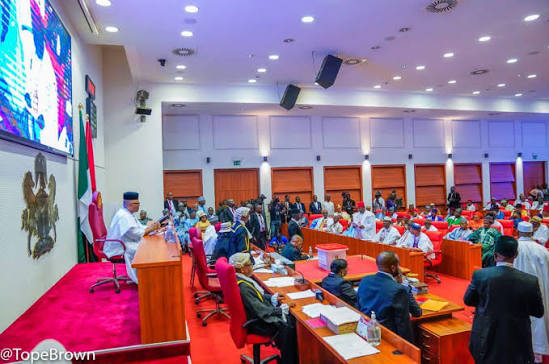
Senate Considers Legislation to Create Multiple Funding for Nigeria Police
Passes the Police Trust Fund Bill to second reading
Asks Police Affairs Committee to conduct public hearing
The Senate, on Thursday, considered a bill seeking to repeal and re-enact the Nigeria Police Trust Fund (Establishment) Act, 2019, with the aim of creating multiple funding sources for the police to tackle persistent challenges affecting its operational capacity.
According to the upper chamber, the proposed legislation provides for one percent of total revenue accruing to the Federation Account for the police; development levies under relevant tax laws; grants and interventions from federal, state, and local governments; donations and international support from bilateral and multilateral partners; as well as private sector contributions and endowments.
Senate Leader, Senator Opeyemi Bamidele, outlined these proposals while leading debate on the bill, stressing the need for a more effective legal framework to support funding, administration, and operations of the police.
He noted that the Nigeria Police faced both acute and chronic funding deficits in 2026, which contributed to insecurity and hindered officers from responding effectively to various security challenges across the country.
Despite billions allocated annually to police operations, many formations continued to operate with minimal funding, relying on unofficial sources for daily activities amid deteriorating infrastructure, poor logistics, inadequate equipment, and dependence on external aid.
The bill, sponsored by Bamidele, aims to boost operational capacity, improve technological capability, and drive infrastructure renewal within police formations, while ensuring predictable and sustainable funding.
During Tuesday’s debate, Bamidele argued that the legislation would promote operational independence within a clearly defined legal structure, alongside diversified funding sources.
He acknowledged that while the current law was commendable, experience had revealed gaps in governance structure, funding sustainability, project execution, and accountability mechanisms.
According to him, “Rather than embarking on piecemeal amendments, this Bill proposes a comprehensive repeal and re-enactment to align its provisions with current realities, global best practices, and Nigeria’s security priorities.”
He emphasized that the diversified funding model would ensure sustainability and reduce reliance on annual budgetary allocations.
Bamidele also listed priority areas for intervention, including procurement of modern security equipment, deployment of digital surveillance and forensic technology, rehabilitation and construction of police facilities, and strengthening of training and capacity development programmes.
He added that once enacted, the bill would enhance intelligence gathering, improve operational efficiency, support emergency response during internal security crises, and boost welfare packages for officers.
The bill further proposes the establishment of a governance framework for the trust fund, including a governing board made up of a retired senior police officer as chairman, representatives from the Ministries of Police Affairs, Justice, and Finance, the police hierarchy, and the organised private sector.
Supporting the bill, Senate Minority Leader, Senator Abba Moro, noted that the trust fund was originally created to address inadequate funding of the Nigeria Police Force, adding that formations still lack modern equipment to effectively tackle crimes such as kidnapping.
“You will recall that one of the problems associated with policing in Nigeria which necessitated the passage of the Police Trust Fund… the time has come to confront the funding challenges facing security agencies, especially the police,” Moro said.
He added that officers often cite lack of resources when responding to abduction cases, noting that criminals are sometimes better armed.
Deputy President of the Senate, Senator Jubril I. Barau, also backed the bill, describing it as vital for national security and stability.
He stated that the Nigeria Police serves the entire federation and that the bill aligns with constitutional provisions, stressing that there was no better time to pass it.
However, Senator Ibrahim Dankwambo cautioned that the proposed one percent deduction from the Federation Account could face legal challenges, recalling that a similar provision had previously been nullified after opposition from state governors.
He also raised concerns about how the funding model would align with ongoing discussions on the establishment of state police.
In his contribution, Senator Buhari Abdulfatai argued that the main challenge facing the police was not just funding volume but inadequate tools and operational support.
He pointed out that Nigeria currently has about 300,000 police officers for a population exceeding 200 million, a figure he described as insufficient by global standards.
Following extensive deliberations, Senate President, Senator Godswill Akpabio, put the bill to a voice vote, with the majority of lawmakers supporting its passage for second reading.
He stated that a public hearing would address key concerns, including accountability for previous trust fund expenditures, alternative funding sources, and compatibility with potential state policing structures.
Akpabio also directed the Senate Committee on Police Affairs to brief leadership on the utilisation of past allocations.
The Senate subsequently referred the bill to the Committee on Police Affairs, chaired by Senator Ahmed Mallam-Madori, with a directive to report back to plenary within two weeks.