
Legislature
Fear and Uncertainty as Ghana’s LGBTQ+ Community Reacts to Tough New Anti-Gay Law

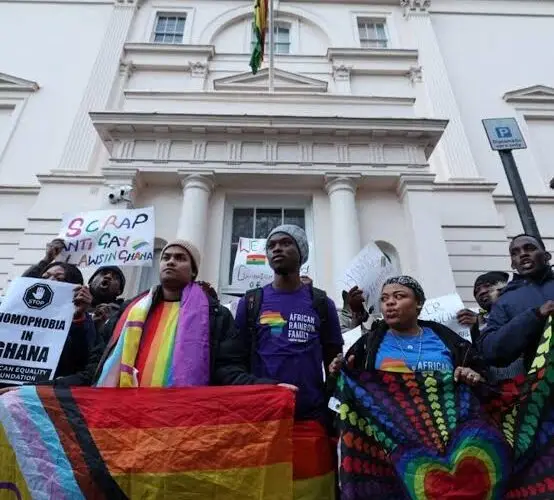
Members of Ghana’s LGBTQ+ community have begun responding to a newly passed law that criminalizes the promotion of LGBTQ+ activities and the identification as lesbian, gay, bisexual, transgender, or queer.
The legislation, approved by the Ghanaian Parliament on Friday, prescribes prison terms ranging from three to 10 years and is awaiting presidential assent from John Dramani Mahama.
In the wake of the bill’s passage, many affected individuals have reportedly turned to support networks and community groups for guidance on how to protect themselves. Discussions have centered on avoiding public attention, concealing personal identities, and minimizing exposure to potential legal consequences.
Advocacy organizations say anxiety is widespread within the LGBTQ+ community, with many individuals concerned about losing their jobs, homes, or access to healthcare services. Some have reportedly begun deleting social media posts and other online content to reduce the risk of being identified.

According to Leila Lariba, Director of One Love Sisters Ghana, an organization that supports lesbian and bisexual women, fear and uncertainty have intensified among community members.
“People are panicking and scared. The new bill affects where you are staying; it can get you evicted; it can lead you to lose your job,” she said.
Lariba added that individuals have been advised to prioritize both online and offline safety by removing potentially sensitive content from social media platforms and exercising caution in their public activities.
Although same-sex relationships were already prohibited under a colonial-era law in Ghana, enforcement was reportedly uncommon. The newly approved legislation significantly broadens the scope of criminal liability, targeting not only LGBTQ+ individuals but also those who provide support, services, or advocacy on their behalf.
Under the bill, identifying as LGBTQ+ could attract a three-year prison sentence, while activities deemed to involve promotion, advocacy, support, funding, or propagation of LGBTQ+ causes could result in jail terms of up to 10 years. The legislation also includes provisions requiring citizens to report suspected LGBTQ+ individuals.
Lawmakers approved amendments exempting healthcare professionals and lawyers from prosecution when providing services to LGBTQ+ persons. However, activists argue that the law may still discourage vulnerable individuals from seeking medical care, HIV testing, or legal assistance because of fear and stigma.
Ebenezer Peegah, Director of Rightify Ghana, criticized the legislation, warning that its impact extends beyond same-sex relationships and could affect civil society organizations, healthcare providers, journalists, and others.
He noted that the organization had documented dozens of cases this year involving alleged exposure, abuse, and eviction of LGBTQ+ individuals. According to him, some community members are considering leaving Ghana, although avenues for support remain limited.
Lariba expressed concern that the law could embolden individuals to harass or discriminate against LGBTQ+ persons, saying such incidents were already occurring and could worsen if the bill becomes law.
A similar measure was passed by Parliament in 2024, but former President Nana Akufo-Addo left office without signing it.
Defending the legislation, its sponsor, Rev. John Ntim Fordjour, told Parliament that the bill was intended to safeguard Ghanaian cultural and family values.
However, Peegah argued that the law has broader implications for LGBTQ+ communities across Africa, drawing comparisons with legislation enacted in neighboring countries.
Rightify Ghana has announced plans to challenge the bill in court, citing concerns over the speed of its passage through Parliament and alleging that the required quorum of lawmakers was not present during the vote.
Photo Caption: Protesters demonstrate against the passage of Ghana’s anti-LGBTQ+ bill.