
Opinion
Patriotism on Display: What Nigeria’s Political Class Should Learn from Davido’s Campaign for His Uncle

By Sam Agogo
As Osun State counts down to its August 15, 2026 governorship election, one of the most compelling stories in Nigerian politics is not about corruption scandals, defections, or power struggles.

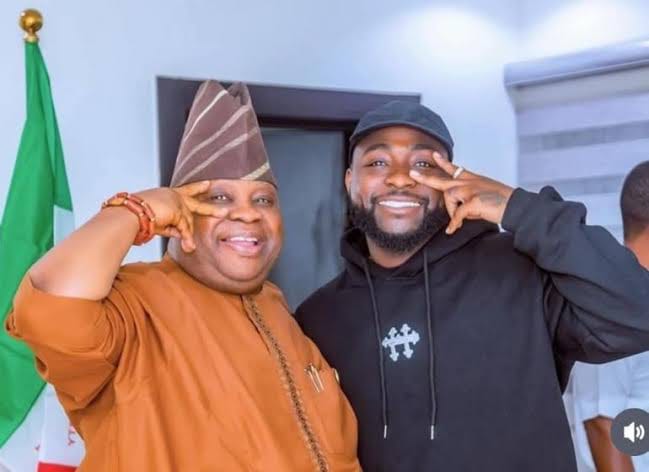
Davido’s political journey began in 2022 when he played a decisive role in his uncle’s first governorship campaign. His influence, charisma, and ability to mobilize young people contributed significantly to Adeleke’s victory over then-incumbent Governor Gboyega Oyetola of the APC. At the time, Davido explained his involvement in simple terms: family is everything. Many dismissed his participation as a one-off gesture, a celebrity lending his star power to a relative’s campaign. But four years later, his renewed and even deeper involvement in 2026 proves that his commitment was not fleeting.
This time around, Davido has gone beyond symbolic appearances. He formally joined the Accord Party in Osun State, collected his membership card, and was appointed Head of Youth Mobilisation for the governor’s re-election campaign. He also chairs the Imole Youth Mobilisation Campaign Council, a structure designed for the hard, unglamorous work of grassroots politics. His consistency is striking in a political environment where loyalty often shifts with convenience, and where alliances are frequently dictated by personal gain rather than conviction.
The true test of Davido’s loyalty came when the campaign faced its most turbulent moments. The EFCC froze Osun State’s statutory allocation account, a move Adeleke’s camp condemned as politically motivated. At the same time, the governor accused rivals of plotting violence and rigging. In such tense circumstances, allies often retreat quietly, waiting to see how events unfold. Davido did the opposite. He publicly declared that his team would still storm Osun despite intimidation, and he convened a press conference urging residents to reject violence and reaffirming his uncle’s record as one of Osun’s best governors.
When governors from other states mocked Adeleke—ridiculing his love for dancing or questioning his credibility—Davido responded directly, defending his uncle and refusing to let the insults go unanswered. His defiance was not limited to words; he backed it with action, showing up at rallies, walking through dense crowds, and dancing alongside his uncle to his own hit song “Feel.” He also took his campaign directly to commercial motorcyclists and tricycle riders, encouraging young Nigerians to come out and vote.
Davido’s closeness to the campaign also placed him at the heart of pivotal political moments. He was present when President Bola Tinubu phoned Governor Adeleke to announce the lifting of the EFCC freeze on Osun’s accounts, a move widely seen as easing tensions before the election. Davido described the moment as historic, underscoring his unique position as both celebrity and political actor. Few young Nigerians, however famous, find themselves in the room for a call of that consequence. That he was there at all speaks to the standing he has built, and the fact that he used it in service of his uncle’s cause rather than his own is worth pointing out.
What makes Davido’s involvement remarkable is that it has been physical, not performative. He has immersed himself in the grinding, unglamorous work of grassroots politics, serving as Chairman of the Imole Youth Mobilisation Campaign Council and leading efforts to energise young voters. His actions highlight a rare blend of loyalty, courage, and civic responsibility. He has shown that patriotism is not about empty gestures but about consistency, sacrifice, and standing firm when the stakes are high.
To enrich this story further, one must consider the broader context of Osun politics and the Adeleke family’s journey. The Adeleke dynasty has long been a fixture in Osun State, with Senator Isiaka Adeleke, the governor’s elder brother, once serving as the state’s first civilian governor. The family’s political legacy is intertwined with its reputation for accessibility and populism, qualities that Davido has amplified through his celebrity reach. His ability to connect with young people, who make up the majority of Nigeria’s electorate, has transformed his uncle’s campaign into a movement that resonates beyond Osun.
Globally, celebrities have often played roles in politics, from Ronald Reagan’s transition from Hollywood actor to U.S. president, to Volodymyr Zelensky’s rise from comedian to president of Ukraine. Yet Davido’s involvement is unique in that he has chosen not to pursue personal political office but to channel his influence into supporting a family member. This choice underscores the depth of his loyalty and the sincerity of his patriotism.
In Nigeria, where political loyalty is often transactional, Davido’s consistency stands out. He has shown up for his uncle in 2022 and again in 2026, not because it was convenient, but because he believes in family and in the cause his uncle represents. His actions challenge Nigeria’s political class to rethink what loyalty and patriotism mean, and to recognise that true commitment is measured not by words, but by consistent action in the face of adversity.
Davido’s story also raises important questions about the role of youth in Nigerian politics. With over 70% of Nigeria’s population under the age of 35, the youth vote is a powerful force. Yet historically, young people have been marginalised in political processes. Davido’s mobilisation of youth in Osun demonstrates the potential of this demographic to shape electoral outcomes and influence governance. His example should inspire other young Nigerians to engage actively in politics, whether through voting, advocacy, or grassroots mobilisation.
The lessons here are profound. Nigerian politicians often speak of patriotism, but too often it is reduced to slogans, flag-waving, or opportunistic speeches. Davido’s actions remind us that patriotism is not about empty gestures or performative displays, but about standing firm in the face of adversity, defending those you believe in, and committing to the hard work of mobilising citizens. His story is a reminder that politics is not only the domain of career politicians. Citizens, celebrities, and ordinary people alike have a role to play in shaping the future of their communities.
As the election approaches, Davido’s story will continue to resonate. It is a story of family, loyalty, courage, and patriotism. It is a story that offers lessons not only for Nigeria’s political class, but for all citizens who believe in democracy and the power of conviction. His actions remind us that patriotism is not about empty gestures or performative displays, but about standing firm in the face of adversity, defending those you believe in, and committing to the hard work of mobilising citizens.
*For comments, reflection, and further conversation, email: samuelagogo4one@yahoo.com or call +2348055847364.*