
Opinion
The Hidden Giants of the Abyss: Creatures Longer Than the Blue Whale

_By Sam Agogo_
Beneath the surface of the world’s oceans drifts a creature that unsettles our neat categories of life.
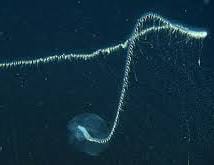
It is not a fish, not a jelly, not a single body at all. The siphonophore is a colony masquerading as an individual, a shimmering ribbon of light and flesh that stretches longer than the greatest whale.
To encounter one is to confront the ocean’s most radical experiment in cooperation: a body made of bodies, a nation that floats, hunts, and glows in the abyss.Scientists classify siphonophores in the order Siphonophorae, within the phylum Cnidaria — the same family that includes jellyfish, corals, and sea anemones. About 175 species are known, most inhabiting the open ocean, from sunlit shallows to the black depths where no light penetrates.

Each siphonophore is built from zooids — specialized units that began as separate individuals but surrendered their independence to serve the colony.
Some zooids are swimming bells, called nectophores, contracting rhythmically to propel the colony.

Others are feeding polyps that digest prey and distribute nutrients. Still others are stinging tentacles, reproductive units, or protective plates. Together, they form a division of labour so complete that biologists often describe the colony as a single body with organs, even though every part descends from separate beginnings.The best-known siphonophore is the Portuguese man o’ war, often mistaken for a jellyfish. With its gas-filled float bobbing like a sail and tentacles trailing metres below, it is both beautiful and dangerous. Its sting can be painful, even life-threatening. Strong winds and currents push these creatures onto beaches, where bathers learn to treat the blue float with caution. Even long after death, the tentacles can deliver venom.
Yet the man o’ war is only a small ambassador of the siphonophore nation. The true giants dwell far below, unseen by most human eyes.In 2020, scientists exploring the deep canyons off Western Australia filmed an enormous siphonophore arranged in a spiralling ring, its length estimated at 45 metres. That is longer than the blue whale, which reaches about 30 metres.
Another deep-sea species, Praya dubia, has long been reported to grow to tens of metres. These fragile chains of zooids may be the longest animals on Earth. The comparison, however, requires nuance. The blue whale outweighs them by far, reaching 150 tonnes, while siphonophores are delicate threads of tissue, nearly weightless for their length.
They are the longest of living things, though not the bulkiest.Siphonophores are not passive drifters.
Many hang in the water with tentacles spread like nets, waiting for crustaceans and zooplankton to stumble into them. Others swim actively, using coordinated contractions of their nectophores to jet through the water, reversing direction with startling agility. Some deep-sea species have evolved lures: faint red lights that attract fish in an environment where most animals cannot see red at all. Light is a recurring theme. Many siphonophores are bioluminescent, flashing blue or green when disturbed. Observers in submersibles describe them as among the most beautiful sights in the deep sea — living chandeliers drifting in eternal night.Siphonophore colonies grow by continually adding new zooids from a growth zone.
Special reproductive zooids release eggs and sperm into the water, and from a fertilised egg a new colony begins, developing its specialized parts in precise order. This sequence fascinates evolutionary biologists, who see in siphonophores a living example of how complex organisms may have emerged from simpler colonial ancestors. Each colony is a story of cooperation written in tissue — a reminder that individuality is not the only path life can take.
Because they are abundant in the open ocean, siphonophores are integral to the marine food web. They consume small animals and serve as prey for turtles, fish, and other creatures.
Their presence helps regulate populations of zooplankton, shaping the balance of ocean ecosystems. Researchers study them not only for their biology but for what they reveal about the deep sea, one of the least explored realms on Earth. Each expedition tends to uncover new species or behaviours, underscoring how much remains undocumented.For discerning audiences, siphonophores offer both wonder and warning.
On beaches, the Portuguese man o’ war reminds us to respect unfamiliar creatures.
In the deep, siphonophores challenge our imagination, glowing and hunting in ways that defy our categories. They show that cooperation can be taken so far that the many truly become one.The siphonophore is more than a biological curiosity.
It is a metaphor for unity, a demonstration that individuality can dissolve into collective purpose.
It blurs the line between organism and community, between self and society.
In its fragile, luminous body, we glimpse the ocean’s creativity — a reminder that life is not bound by our definitions.
To watch a siphonophore drift through the abyss is to witness a floating nation, longer than the mightiest whale, glowing with secrets we are only beginning to understand.
*For comments, reflections and further conversation, email: samuelagogo4one@yahoo.com or call +2348055847364.*