
General News
Experts Warn Against Rubber-Stamp Legislature, Excessive Opposition

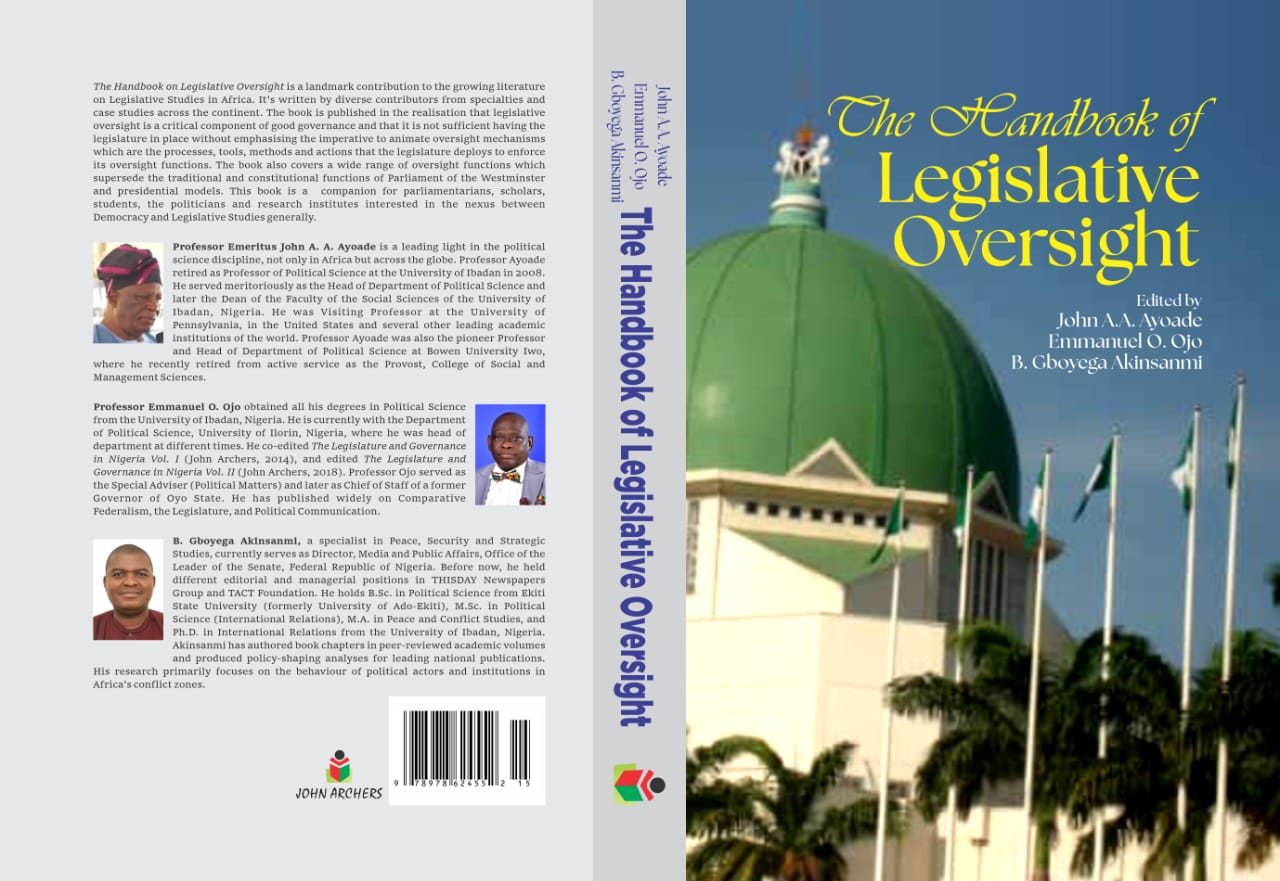
Leading political scientists have challenged the political class, warning that both antagonism and uncritical cooperation are enemies of good governance. They noted that the three arms of government are expected to pursue the common goal of delivering the best service to the people.
The concern was expressed in a statement jointly issued on Sunday by Emeritus Prof. John Ayoade, Prof. Emmanuel Ojo, and Dr. Babatola G. Akinsanmi to unveil The Handbook of Legislative Oversight, a newly published book that examines both horizontal and vertical modes of legislative oversight.
In their statement, the trio of Ayoade, Ojo, and Akinsanmi explained the centrality of legislative oversight to public governance in democracies across the world, describing it as part of the ingenious and intricate system of checks and balances and quality control among the arms of government.
The scholars emphasised the importance of legislative oversight in a democratic political system and the responsibility of lawmakers to enforce, protect, and nurture it, noting that it is fundamental to their mandate and their representational article of faith.

They further argued that legislation without oversight essentially “nullifies the legislature because it practically lets loose the executive. Oversight, in reality, is a control mechanism that guides the behaviour of public institutions.”
They said: “Such an eventuality will neutralise the ameliorative braking philosophy that informs the separation of powers, with consequential effects. It does not only make the legislature redundant, but it also creates a functional vacuum in the representation of the electorate.

“In effect, therefore, the electorate is vicariously delinked from governance. It is not only the absence of oversight that portends such calamity for governance, as poor, inefficient, and collusive oversight has an equally deleterious effect.
“A legislature that intentionally or inadvertently surrenders its right and power of oversight abdicates its mandate and compact with the people. Such self-abnegation by the legislature for any reason is a simultaneous betrayal of both the people and the mandate.”
Citing diverse empirical evidence from Africa’s democracies, the scholars also argued that camaraderie “is a delicate balance between amity and opposition, operating, in effect, as cooperative antagonism.
“When the balance is skewed in favour of opposition, as between Ghali Na’Abba and Obasanjo in Nigeria, oversight becomes adversarial. On the other hand, when the relationship is too cosy and cordial, the legislature is seen as a rubber stamp.
“Either way, good governance is the loser. The equilibrium is most at risk when different political parties control the legislature and the executive. This is not to say that the equilibrium cannot be threatened where the same party controls the two arms of government.
“The three arms are supposed to pursue the common goal of the best service to the people, but what is best may be defined differently, just as the methodology for its attainment. The delicate nature can be summarised in the statement that antagonism, as much as uncritical cooperation, are enemies of good governance.”
The scholars explained that the new publication is aimed at sensitising legislators to this critical aspect of their responsibilities and providing them with essential rudiments of the theory and practice of legislative oversight to improve their oversight skills.
The book was published by John Archers (Publishers) Limited, with no fewer than 10 Professors of Law and Political Science contributing to the 19-chapter publication, which examines legislative oversight on the continent from different perspectives.