
Governance
INEC Boosts Staff Salaries, Increases State Offices’ Funding Ahead of 2027 Elections.

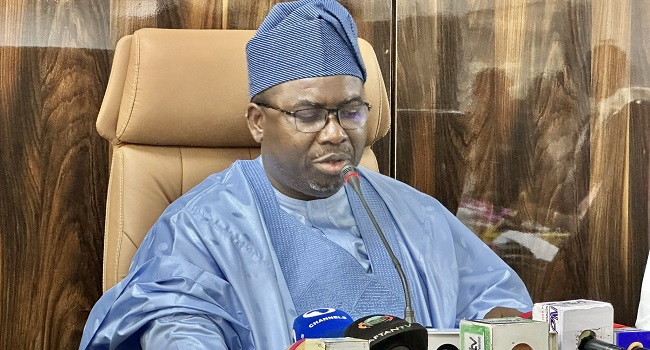
The Independent National Electoral Commission (INEC) has approved an increase in staff salaries and a 150 per cent rise in monthly funding for its state offices as part of preparations for the 2027 general elections.
INEC Chairman, Prof. Joash Amupitan, disclosed this on Friday during a meeting with staff in Lokoja, organised to assess the level of preparedness of North-Central states for the elections.
He explained that the new salary structure took effect on January 1, 2026, while efforts are ongoing to provide the funds required for its implementation.
The additional funding for state offices commenced on July 1, 2026. Staff members will also benefit from improved field and hazard allowances.
Amupitan said the commission had also procured vehicles for its offices, with pick-up vans distributed to state and local government offices across the country.

He added that INEC had purchased 20 SUVs for Resident Electoral Commissioners, while Administrative Secretaries would also receive new vehicles.
However, the chairman stressed that improved remuneration must be accompanied by responsible conduct, announcing that staff had been directed to suspend annual leave for the time being.

He warned that any staff member found absent from duty, engaging in partisan politics, demonstrating negligence or misusing funds would face disciplinary action.
“Every staff member must remain neutral, professional and committed to the electoral process,” he said.
Speaking on the technological preparations for the elections, Amupitan disclosed that about 57,000 new Bimodal Voter Accreditation System (BVAS) machines were being configured to accredit voters.
He said the systems responsible for transmitting results from polling units to the INEC Result Viewing Portal (IReV) were also undergoing checks to ensure transparency and credibility.
The commission has equally introduced printable voter cards and an online portal to assist voters in locating their cards.
According to him, the preliminary voters’ register has been released for public scrutiny.
He stated that the final register would be published on December 15, 2026, adding that concerns raised over some photographs would be addressed before its release.
The INEC chairman identified insecurity and fake news as major threats to the forthcoming elections.
To strengthen security, he said the commission would coordinate all security agencies down to the local government and ward levels.
The agencies include the military, police, Department of State Services (DSS), Nigeria Security and Civil Defence Corps, Customs, Immigration, Correctional Service and Federal Road Safety Corps.
He warned that anyone who threatens or attacks election officials, including members of the National Youth Service Corps (NYSC), would be dealt with in accordance with the law.
Amupitan also raised concerns about the circulation of fake videos and photographs generated through artificial intelligence.
He maintained that the best way to counter misinformation was to conduct transparent and credible elections, noting that delayed commencement of voting and technical challenges could create opportunities for rumours and false reports to spread.
The North-Central zone has 15,448,869 registered voters across Benue, Kogi, Kwara, Nasarawa, Niger, Plateau and the Federal Capital Territory.
Nationwide, more than 103 million voters are registered across 176,846 polling units.
Amupitan disclosed that INEC had completed nine of the 14 major activities outlined in its election timetable.
The presidential and National Assembly elections are scheduled for January 16, 2027, while the governorship and State Houses of Assembly elections will take place on February 6, 2027.
The Kogi State Resident Electoral Commissioner, Dr Alhaji Shehu L. Wahab, said his office was intensifying preparations for the elections.
He explained that the commission also had additional responsibilities following the restoration of 12 state constituencies.
Wahab added that the office was collaborating with security agencies to change the perception of Kogi State as a violent state during elections.
The Lokoja meeting marked the conclusion of INEC’s series of nationwide election readiness assessments. Similar meetings had earlier been held across the South-West, North-West, South-East, North-East and South-South geopolitical zones.