
Opinion
My Experience At The Parking Lot

Dr Jalarth Uche Opara
I have a rather unusual challenge. I find it difficult to allow an event to pass without giving it a positive disruption, to look beyond the ordinary and discover a lesson that may not be immediately obvious. I have tried severally to overcome this tendency, but it seems as difficult as passing a camel through the eye of a needle.
Yesterday, I had an interesting encounter with some of our church traffic marshals, who do a fantastic job every Sunday, ensuring a seamless flow of vehicles within the church premises.
Driving into church after the 8 a.m. Mass, I discovered that not a single space was available in my favourite parking spots.
As I manoeuvred towards another section, I nearly hit a Prado Jeep behind me, but for the timely intervention of a security man.
As I regained my bearing, I noticed a Lexus SUV, apparently one of the latest models, preparing to drive out.

Between it and the space I hoped to occupy were other impressive SUVs, including Mercedes-Benz and Toyota models.
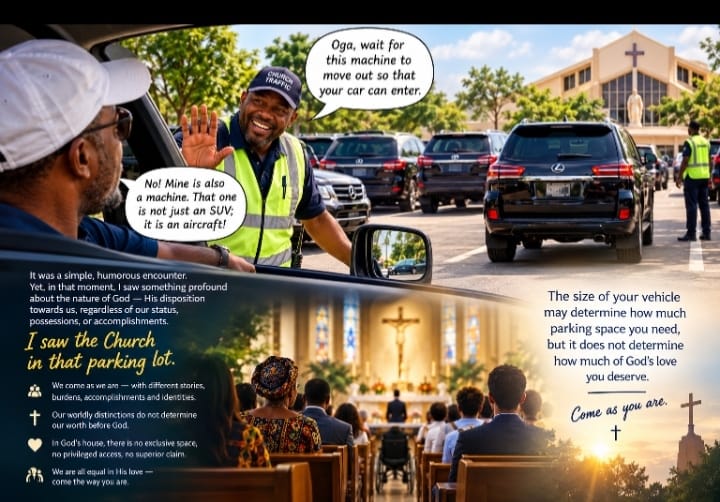
One of the security men signalled me to wait. I wound down my window, and with a smile, he said, “Oga, wait for this machine to move out so that your car can enter.”
Without missing a beat, I replied humorously, “No! Mine is also a machine. That one is not just an SUV; it is an aircraft!”
Eventually, the Lexus drove out, and I gently manoeuvred my humble vehicle into the space it had vacated, comfortably sandwiched between two SUVs.
It was an ordinary, humorous encounter. Yet, in that moment, I saw something profound about the nature of God and His disposition towards us, regardless of our status, possessions, or accomplishments.
I saw the Church in that parking lot.
The parking lot became a metaphor for God’s house, a place where nobody should imagine that access to God is determined by the size of one’s vehicle or one’s social standing.
We come into God’s presence with different stories, burdens, accomplishments, and identities. Some are celebrated; others are barely noticed. Yet, our worldly distinctions do not determine our worth before Him.
We may sit beside people whose wealth, qualifications, and social status differ enormously from ours. We may sing the same hymns, kneel at the same altar, and receive the same Eucharistic Lord.
Our differences in status must never become differences in human dignity.As St. Peter declares in Acts 10:34, “God shows no partiality.”
God’s love is not a commodity reserved for the wealthy, influential, or accomplished.
There is no exclusive ownership of His mercy, and no material possession confers privileged access to His heart.The Church is not a showroom for displaying our achievements or a social club where our worth is measured by the brands we wear and the positions we occupy. It is a place where grace meets humanity, where the broken seek healing, and where every soul is reminded of its dependence on God.
Being equal before God does not mean that we are identical in our gifts, responsibilities, or circumstances. It means that none of these makes one person inherently more deserving of His love than another.
Perhaps that was the lesson I nearly drove past yesterday.
I went to church looking for a parking space. I left that encounter thinking about the nature of God.
Who is God?
He is the God before whom a Prado and my humble car may occupy different spaces in the world, but neither vehicle determines the worth of the soul behind its steering wheel.
He is the God whose house must never become a monument to human hierarchy, but a sanctuary of divine grace.
Come as you are, with your brokenness, questions, failures, hopes, and gratitude.
Remember this: the size of your vehicle may determine how much parking space you need, but it does not determine how much of God’s love you deserve.
Share your experiences with me to turn them into spiritual lessons.
Jarlath Uche Opara
jarlathuche@gmail.com