
General News
Egypt Leads Africa in Fruit and Vegetable Production Despite Limited Arable Land

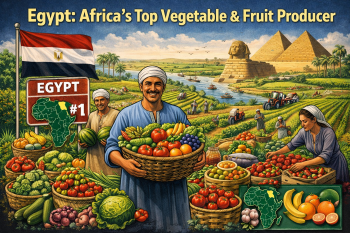
Egypt has emerged as Africa’s leading producer of vegetables and fruits, topping continental output for key staples such as wheat, tomatoes, onions, potatoes, cucumbers, garlic, oranges and sugar beet, while also ranking among the top producers for several other crops—despite having one of the smallest arable land areas on the continent.
Main production claims: What the data shows
Based on recent data from the Food and Agriculture Organization (FAO) and sector analyses covering roughly 2017–2024, several elements of the claim are broadly accurate:
Wheat: Egypt remains Africa’s largest wheat producer, with annual output averaging between 9–10 million tonnes in recent years, surpassing Ethiopia and contributing about 17 percent of the continent’s total production.
Tomatoes: The country leads Africa in tomato production, harvesting more than 6 million tonnes in 2022 and maintaining the top position for over six decades according to FAO data.
Dry onions and garlic: Egypt is the continent’s leading producer of both dry onions and garlic, with garlic output estimated at about 500,000 tonnes in 2024—roughly double that of Algeria and Ethiopia combined.
Potatoes and cucumbers: It also ranks first in the production of potatoes and cucumbers, supported by irrigation-intensive agriculture along the Nile Delta and newly reclaimed lands.
Oranges: Egypt stands as Africa’s top producer and exporter of oranges, with annual output nearing 3.7 million metric tonnes, ahead of countries like South Africa.
Sugar beet: The country is among Africa’s leading producers of sugar beet, expanding cultivation to over half a million feddans (about 215,000 hectares) to strengthen domestic supply and exports.
Some secondary rankings are broadly accurate but may vary slightly depending on the year and data source:
Cabbages, grapes, lemons, mangoes: Egypt is a major producer of these crops and often ranks among the top two in Africa for mangoes, although exact positions fluctuate.
Maize and carrots: The country is typically among Africa’s top ten producers, ranking around fourth in maize and fifth in carrots in recent datasets, though these positions can shift annually.
Land constraint: Desert vs arable reality
Estimates indicate that Egypt’s arable land spans about 3.5 million hectares, placing it among the countries with relatively limited farmland in Africa. With nearly 96 percent of its territory classified as desert, agricultural activities are concentrated along the Nile Valley and Delta, as well as in reclaimed desert areas.
Despite this limitation, advancements in irrigation, improved farming technologies and intensive cropping systems have enabled Egypt to achieve high productivity levels relative to its land size.
Caveats and context
While the “2017–2024 average” is not presented as a single official FAO dataset, it aligns with observed trends from annual reports and continental rankings.
Additionally, some claims—particularly those placing Egypt as the “second highest” producer of certain crops—should be viewed as approximate due to variations in reporting frequency and data availability across African countries.
What this means for food security and trade
Egypt’s strong performance in fruit and vegetable production supports both domestic food security and a growing export market across Europe, the Middle East and parts of Asia. However, the country remains the world’s largest importer of wheat, reflecting a gap between local production and high consumption demand.
Overall, the data supports the central claim: Egypt leads Africa in the production of wheat, tomatoes, onions, potatoes, cucumbers, garlic, oranges and sugar beet, while maintaining top-tier rankings in several other agricultural commodities—all achieved from a relatively small and largely desert-constrained arable base.