
International
US Congressman Riley Moore warns of possible American intervention over Nigeria’s worsening security crisis.

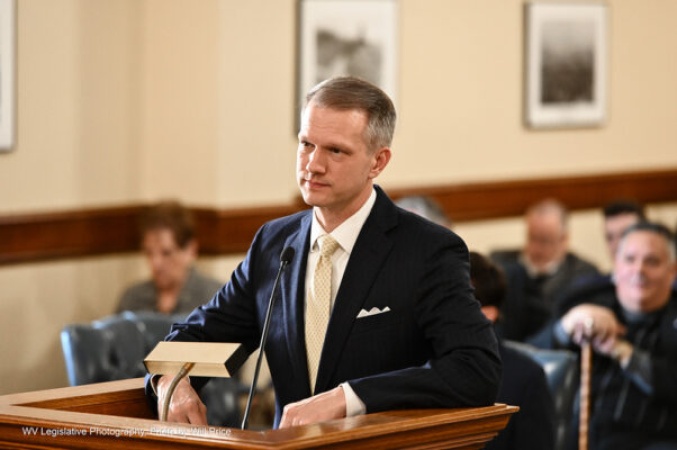
A United States congressman, Riley Moore, has cautioned that the US could take a direct role in addressing Nigeria’s security challenges if authorities do not act swiftly to stop the ongoing killings.
Speaking during an interview with Newsmax on Wednesday, Moore revealed that a report he submitted to the White House last month contained “concrete actions” aimed at tackling what he described as escalating violence against Christians in Nigeria.
“This report that we presented to the White House was pursuant to the president asking myself and Chairman Tom Cole to investigate this Christian persecution and what I’ve been calling a genocide in Nigeria,” he said.
Moore, who recently visited Nigeria, stated that he witnessed the situation firsthand. “We went there. I saw it with my own eyes, the tragedy and horror that’s unfolding there,” he added.
He referenced recent attacks, including a Palm Sunday incident and another at a Christian wedding. “We’ve had 40 individuals who were killed at a Palm Sunday service, and then on top of that, you had another 13 Christians killed by Islamic radical militants at a Christian wedding,” he said.
The remarks come amid renewed violence in Plateau State, where 28 people were reportedly killed in Angwan Rukuba, in Jos North Local Government Area. Governor Caleb Mutfwang described the attack as “tragic” and “senseless,” assuring that those responsible would be brought to justice.
The incident followed earlier reports that at least 20 security operatives and vigilantes were killed in an ambush in Kanam Local Government Area, highlighting the persistent insecurity affecting the state and neighbouring regions where communities continue to face attacks, kidnappings, and cattle rustling.
Moore warned that Washington could intensify its involvement if Nigerian authorities fail to act decisively. “As President Donald Trump has been very clear on this, if they don’t address this, we’re going to address it for them,” he said.
“We’d like to do that in cooperation and coordination, but if they don’t step up to the plate here, we’re going to start to take the lead.”
The United States currently maintains a limited military presence in Nigeria, with about 200 personnel providing training and intelligence support to Nigerian forces.
Moore added that US assets in the region include MQ-9 Reaper drones and referenced a Tomahawk cruise missile strike around Christmas targeting Islamic State and Boko Haram militants. Despite these efforts, he noted that extremist groups continue to operate “largely unfettered.”
“The Nigerian government has been trying to make some steps toward this, but they’re not doing it fast enough. Things aren’t happening quick enough, and these things keep happening,” he said, adding that “something’s got to give here.”
According to Open Doors, a global Christian charity cited during the interview, Nigeria ranks as the seventh worst country for Christian persecution and accounted for about 72 per cent of Christian killings worldwide last year.
Moore’s claims have, however, sparked debate. A report by The New York Times stated that some US lawmakers have “falsely claimed” that a Christian genocide is occurring in Nigeria, noting that the violence is complex and affects people of different faiths. The Nigerian government has also repeatedly rejected such assertions.
Responding, Moore criticised the report, saying, “This is disgusting. A new low, even for The New York Times,” and accused the newspaper of failing to seek his input.
He maintained that while multiple factors may be contributing to the violence, “there is a systemic effort by Islamic radicals to eliminate Christian populations within Nigeria.”
The development follows earlier warnings by Moore that continued attacks on worshippers during Christian holy days could strain diplomatic relations, amid growing calls for stronger security measures and a coordinated international response to Nigeria’s worsening security situation.