
Crime
How Terrorists Are Using Forest Routes to Reach Southern Nigeria

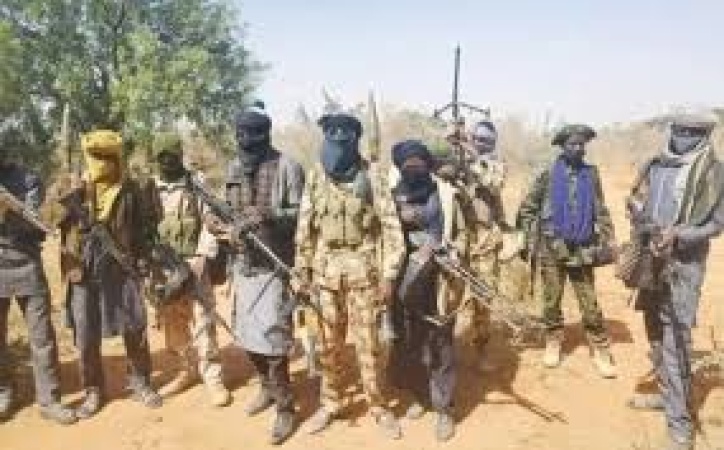
Many terrorists displaced from Zamfara and Sokoto states have reportedly relocated to the South-East and South-South regions, according to security and intelligence sources who spoke with Saturday PUNCH.
The sources said the insurgents are taking advantage of interconnected forest corridors and riverine routes stretching through Niger, Kogi and Anambra states as they seek to evade military operations in the North.
Among those who confirmed the development were a security chief, a retired Army General and an officer of the Department of State Services (DSS). They disclosed that the terrorists move through Niger and Kogi states into Anambra before spreading into Abia and Imo states, while some continue further south.
A security chief stated, “These terrorists started moving from Zamfara; they went through the bushes and forests and might have ended up in other states, including Imo and Abia. Some are even in Ogun State.”
The source added that members of the Ansaru group, as well as Sadiku, Masua and other factions, are operating in Niger, Kwara and parts of the South-West.
“The Ansaru group, Sadiku, Masua and other groups are in Niger, Kwara and some parts of the South-West. Very soon, we are going to get them. They have been degraded,” he said.
Kogi Identified as Strategic Hub
Explaining the movement pattern of the terrorists, a retired Army General said the insurgents rely heavily on the Niger River corridor in eastern Kogi State, particularly in Igala land, to cross into Anambra State and proceed to Imo and Abia.
“The connecting links for these terrorists are the forests that network the North (Zamfara–Benue–Niger–Kogi) with the South-East and South-West: Anambra, Ekiti and Ondo states, to be specific,” he explained.
The retired General described Kogi as a major intersection for terrorist activities, noting that the state serves as a coordination and logistics centre.
“The terrorists are guided by cattle paths in the bush; I am not saying they are herders because herders are also victims of banditry or terrorism. The bandits kill them and rustle their cattle. That is why you see herders moving with their cattle on major roads,” he said.
According to him, the terrorists exploit cattle routes within forests due to transhumance activities.
“So, they use the cattle routes in the forests because there is transhumance. The intersecting points are Kogi and Kwara. They connect to the South from those states through the Oyo National Park and the riverine and forested terrain along the Niger River in Igalamela-Odolu and Ofu Local Government Areas of Kogi,” he added.
He also linked the current security challenges to past political developments in the area.
“Kogi is central to their planning. It is like the centre point, maybe for convergence and strategy. Unfortunately, a former Kogi governor, who introduced violence in that area and armed some criminals, disbanded those boys. But the guns were not recovered. Some of those boys are now with the terror groups. That is why if some Boko Haram members are arrested today, you see a lot of boys from Kogi, particularly Ebira and the Igala area,” he said.
Southern Transit Routes
A DSS officer also confirmed the development, saying the forest pathways in Niger State connect a wide network of states including Niger, Kwara, Kogi, Oyo, Ondo and Ekiti.
“They have a command centre in Kogi where they train and strategise. There is a forest in Kogi that links the Ikole/Ijero forest and the Ogbese Forest Reserve in Ekiti State. That forest also links Ose and Ikare in Ondo State. They gain access to Edo State through that route,” the officer stated.
Findings by Saturday PUNCH showed that Ose shares a direct boundary with the Owan area of Edo State, creating one of the most direct links into the South-South region.
Further investigations revealed that the Owerre-Ezukala, Ogbunike and Awka-Orlu axis between Anambra and Imo states contains dense forests, deep valleys and difficult terrain, making it a suitable route for fleeing insurgents.
Likewise, the Ihiala-Orlu-Okigwe corridor connecting parts of Anambra and Imo states is covered by extensive vegetation and bush paths that provide natural concealment.
In Abia State, the Umunneochi-Isuikwuato axis, located close to the Imo and Anambra borders, features hilly landscapes and forested areas that connect directly to the wider South-East forest belt.