
Opinion
How the Assassination of Shinzo Abe Exposed a Church, Toppled Political Alliances, and Ended in a Landmark Dissolution Ruling

By Sam Agogo
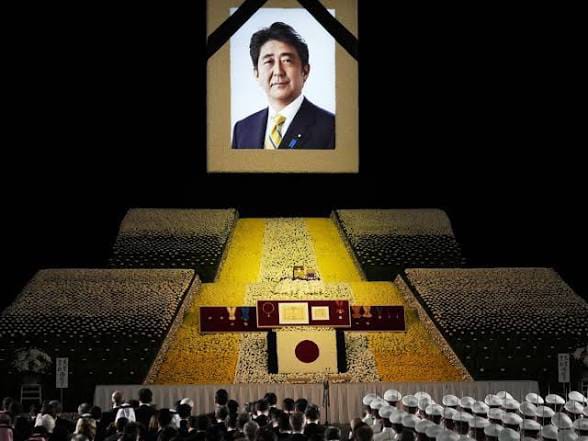
The gunfire that ended the life of Shinzo Abe on a dusty street in Nara on the afternoon of July 8, 2022, did not begin as a political act. It began as a private grief that had festered for two decades inside the mind of a 41-year-old former naval officer named Tetsuya Yamagami. Abe, Japan’s longest-serving prime minister, was addressing a campaign rally for a parliamentary election when a man stepped out from behind him and fired twice from a crude, handmade weapon fashioned from pipes, wood and tape. Abe collapsed, was airlifted to hospital, and was pronounced dead hours later. Yamagami did not run. He stood where he was and let the police take him.
What emerged in the days and months that followed was not the profile of an ideological assassin but the story of a broken household. Yamagami’s mother had, over many years, donated roughly 100 million yen — the equivalent of well over half a million dollars — to the Unification Church, formally called the Family Federation for World Peace and Unification. The donations bankrupted the family, drove his father to suicide, and left Yamagami and his siblings in poverty and social isolation through their formative years. He grew to blame the church for the ruin of his family, and Abe, in his eyes, had lent the church legitimacy through decades of association with it — a relationship that traced back to his grandfather, former prime minister Nobusuke Kishi, who had backed the church’s entry into Japan in the 1960s as part of a broader anti-communist alliance. Yamagami did not attack Abe over policy. He attacked him as a symbol of the political cover that had, in his understanding, allowed the church to keep extracting money from families like his own, unchecked, for generations.
He was arrested at the scene, tried at the Nara District Court, and in January 2026 sentenced to life imprisonment after admitting, from the very first hearing, that everything the prosecutors alleged was true. The court found the act premeditated — he had spent months building and testing the weapon in the mountains — but the trial, more than a referendum on Yamagami himself, became a public airing of everything the assassination had unearthed about the church he held responsible for his family’s collapse.
That reckoning is now complete. On June 22, 2026, Japan’s Supreme Court, sitting as the Third Petty Bench, dismissed the church’s final appeal and upheld the order compelling its dissolution as a legal religious corporation. The four justices were unanimous. The court held that the church’s decades-long pattern of soliciting donations had caused sustained financial and psychological harm to large numbers of people, and that this amounted to conduct substantially injurious to public welfare, satisfying the threshold for dissolution under Japan’s Religious Corporations Act. It is the first time in the country’s post-war history that a religious body has been stripped of its legal status for violations rooted in the Civil Code rather than criminal conviction. With the ruling final, the church loses its tax-exempt status, its properties pass into liquidation, and a court-appointed liquidator oversees the winding down of an organisation that once operated hundreds of chapters and considerable commercial interests across Japan.
The path to that judgment had run through two lower courts. The Tokyo District Court issued the first dissolution order in March 2025, following a request the Education Ministry had filed back in 2023 once the Abe investigation exposed the scale of the church’s fundraising practices. The Tokyo High Court upheld that order in March 2026, citing damages running into billions of yen suffered by victims of the church’s donation solicitation stretching from the early 1970s through 2016. The Supreme Court’s confirmation in June closed the matter for good, though not without controversy — critics of the ruling, including some religious liberty advocates, argued the court had stretched the law by holding an entire corporation liable for the conduct of individual believers, some of it decades old and none of it criminal. The government and the majority of Japanese public opinion saw it differently: a reckoning long overdue for an organisation that had, for half a century, treated the guilt and fear of ordinary Japanese families as a revenue stream.
To understand how a Korean religious movement came to hold such a grip on Japanese households, one has to go back to 1954, when Sun Myung Moon founded the Holy Spirit Association for the Unification of World Christianity in Seoul, South Korea, blending elements of Christian theology with his own claims of a divine mission to complete the work of Christ. The movement crossed into Japan in the late 1950s and found fertile ground there for reasons that had little to do with theology. Post-war Japan was gripped by anti-communist anxiety, and Moon’s movement, fiercely anti-communist in orientation, found powerful patrons among conservative Japanese politicians who saw it as a useful ally in that ideological struggle. Chief among those patrons was Nobusuke Kishi, Abe’s own grandfather, whose backing helped the church secure formal recognition as a religious corporation in Japan in the 1960s. From that foothold, the church built a permanent and unusually intimate relationship with the conservative wing of Japanese politics that would endure for more than sixty years, long after the Cold War logic that had first bound them together had faded.
It was inside Japan that the church’s fundraising apparatus reached its most aggressive form, through what became known as “spiritual sales” — reikan shoho — a practice in which church representatives approached often lonely, grieving or anxious individuals and convinced them that ancestral curses, unresolved spiritual debts, or the suffering of the dead required the purchase of extraordinarily overpriced religious items: miniature pagodas, ceremonial vases, seals, prayer beads, sold for hundreds of thousands or even millions of yen apiece. Members were told that failing to pay would visit misfortune upon their families, their health, their marriages, their children. Investigators who later reviewed decades of complaints found that the church had extracted over 20 billion yen — more than 130 million dollars — from victims through this and related schemes, much of it from people who sold homes, drained retirement savings, or borrowed heavily to meet the sums demanded of them. Court findings during the dissolution proceedings detailed damages of roughly 7.4 billion yen suffered by victims across the period between 1973 and 2016 alone, a figure the judges called only a portion of the true toll, since many victims never came forward.
A significant share of what was raised in Japan did not stay in Japan. For years, journalists, defectors and Japanese lawmakers alleged that enormous sums collected from Japanese followers were funnelled back to the church’s headquarters and affiliated enterprises in South Korea, treating the Japanese membership as a financial base to be tapped in service of the organisation’s global operations and the Moon family’s business empire, which spanned media outlets, universities, a car manufacturer, and other ventures. Former members described being taught that Japan bore a unique spiritual debt to Korea because of its colonial-era conquest of the peninsula, a debt that could only be atoned for through sacrificial giving — a theology that, whatever its sincerity to its architects, functioned in practice as a highly effective instrument for directing Japanese wealth outward.
What turned decades of quiet complaint into a national reckoning was Abe’s assassination. Once Yamagami’s motive became public, Japanese investigative journalists and opposition lawmakers began pulling at a thread that unravelled further than almost anyone expected. It emerged that more than half of the lawmakers in the ruling Liberal Democratic Party had, at some point, received support from the church or its members — campaign volunteers, endorsements, event attendance — support the church appeared to trade for political cover and the tacit protection that came with proximity to power. Several senior officials, including a former defence minister, admitted receiving election assistance from church-linked volunteers. The revelations forced the resignation or reassignment of multiple cabinet members, and then-prime minister Fumio Kishida purged officials with church ties from his government and pledged to sever the party’s relationship with the organisation. The damage to public trust, however, was already done, and the pressure that followed pushed the Education Ministry to do what no Japanese government had dared attempt in the church’s sixty-year history in the country: seek its dissolution as a legal entity.
There is a lesson in all of this for Nigeria, and it does not require much translation. What destroyed the Yamagami family, and what ultimately brought down one of the most politically entrenched religious organisations in modern Japanese history, was not a single scandal. It was a business model — a theology engineered so that the fear of spiritual consequence became indistinguishable from a sales pitch, and where refusing to give was recast not as a financial decision but as an act of rebellion against God, ancestors, or destiny. Nigeria’s religious landscape, and its Pentecostal circuit in particular, has normalised versions of this same model on a scale that should trouble anyone paying attention. The demand for “seed” before a breakthrough, healing, promotion, marriage or safe delivery; the ranking of givers by the size of their offering; the public shaming, subtle or open, of those who cannot give; the insistence that hardship itself is evidence of insufficient sowing — these are not far removed from the reikan shoho that Japanese courts have now formally recognised as exploitative. Nigerian families have sold land, withdrawn children’s school fees, gone into debt and, in some documented cases, been driven to ruin chasing a promised harvest that never comes, convinced the fault lies in their own faith rather than in the arithmetic of the demand placed on them.
Japan needed a court case that took more than three years, and the killing of a former prime minister, before its institutions were willing to confront a religious organisation that had grown too politically useful to touch. Nigeria has neither the judicial tradition nor, frankly, the political will that finally produced that reckoning in Tokyo. What it has is a steadily accumulating record of families quietly broken by the same pattern the Japanese courts have just spent a year and a half documenting in painstaking, monetary detail — except that in Nigeria’s case, almost none of it is measured, litigated or ever brought before a judge. The Unification Church’s dissolution should not be read by Nigerian pastors, or by the congregations that fund them, as a distant foreign scandal. It is a mirror, and what it shows is not especially flattering.

For comments, reflections and further conversation, reach me at samuelagogo4one@yahoo.com
+2348055847364