
General News
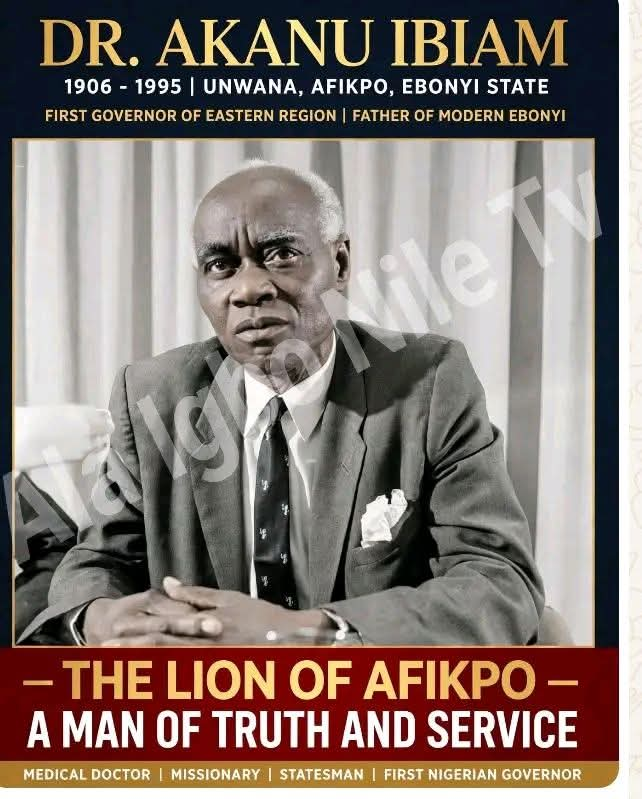
DR. AKANU IBIAM — THE DOCTOR WHO BECAME A GOVERNOR, AND THE GOVERNOR WHO REFUSED TO SELL HIS CONSCIENCE

🇳🇬
The Man Who Healed Bodies, Healed A Nation, And Never Bowed To Evil
29 November 1906 — 1 July 1995
Unwana, Afikpo, Ebonyi State
Ndi Igbo, do you know this man?
His name is on our Airport in Enugu.
His name is on our Polytechnic in Unwana.
But many of our children do not know who he really was.
Today, let us remember him properly.
This is the story of Dr. Akanu Ibiam.
—
👶 1. FROM A SMALL VILLAGE TO THE WORLD STAGE
Akanu Ibiam was born on 29th November 1906 in Unwana, Afikpo, in what is today Ebonyi State.
He was the second son of Chief Ibiam Aka, a traditional ruler of Unwana.
He was not born rich.
He was not born with a silver spoon.
He was born in a village where many children never saw a classroom.
But he had something money cannot buy — discipline, faith, and a heart to serve.
From Unwana, he went to Hope Waddell Training Institution, Calabar, then to King’s College, Lagos, where he passed with distinction.
His elder brother Samuel saw his brilliance and sponsored him abroad.
He entered University of St. Andrews, Scotland — one of the oldest universities in the world — and in 1934, he graduated as a medical doctor.
He became one of the first Igbo medical doctors ever, and the first African medical missionary of the Church of Scotland.
A village boy became a world-class doctor.
That is Igbo spirit.
—
🩺 2. THE DOCTOR WHO CHOSE THE VILLAGE OVER MONEY
When Akanu Ibiam returned to Nigeria in 1935, he could have taken a big government job in Lagos.
He could have lived in comfort.
He could have charged rich people big money.
He refused.
He chose to be a medical missionary.
He went to the villages where nobody wanted to go.
He built Abiriba Hospital (1936 – 1945) from a small dispensary, serving Abiriba, Ohafia, Item, Igbere, Nkporo and all the surrounding villages.
He later supervised mission hospitals at Itu and Uburu.
He specialised in eye medicine — Ophthalmology — at Moorfields Eye Hospital, London, because he saw many of our people going blind from diseases that could be cured.
He treated the poor for free.
He cared for mothers and children.
He promoted maternity work and child welfare when many hospitals ignored women.
He did not see patients as numbers.
He saw them as brothers and sisters.
He was a doctor with the hands of a surgeon and the heart of a pastor.
—
📚 3. THE TEACHER WHO BELIEVED IN EDUCATION FOR ALL
Akanu Ibiam believed that if you educate one Igbo child, you have liberated a whole family.
He became the first Nigerian Principal of Hope Waddell Institution, Calabar in 1957.
He was a vigorous advocate for free and universal primary education.
He was one of the early voices calling for a Nigerian University — so our children would not need to travel to London to learn.
In 1959, he became President of University College, Ibadan.
In 1962, he chaired the committee that established the Protestant Chapel at University of Nigeria, Nsukka.
He believed education was not for the rich alone.
Education was for every child in Ala Igbo.
—
🏛️ 4. THE GOVERNOR WHO FEARED GOD MORE THAN POLITICIANS
After Nigeria gained independence in 1960, Akanu Ibiam was appointed the First Governor of Eastern Nigeria.
He served from December 1960 to January 1966.
His office was ceremonial, but his character was not.
He used that office to preach morality, merit, and justice.
Here is what made him different:
He refused to sign a bill to legalise gambling / lottery in the Eastern Region.
He said he would rather resign than sign a law that would destroy families. The bill died. He did not bend.
He condemned corruption openly.
In a time when many leaders were already stealing, he spoke against it without fear.
He opposed tribalism.
He insisted that appointments must be by merit, not by tribe. He said: “Credibility rather than Ethnicity. Meritocracy rather than mediocrity.”
He believed Nigeria could never progress if injustice and ethnic prejudice continued.
He was a Governor who did not steal.
A Governor who did not lie.
A Governor who did not fear men.
That kind of Governor is rare today.
—
✝️ 5. THE CHRISTIAN LEADER THE WHOLE WORLD RESPECTED
Akanu Ibiam was not just a politician. He was a man of deep faith.
He was ordained as an Elder of the Presbyterian Church.
He served as President of the Christian Council of Nigeria (1955 – 1958).
He helped found the Bible Society of Nigeria and the Christian Medical Fellowship.
He became a President of the All Africa Conference of Churches and one of the Six Presidents of the World Council of Churches.
The whole Christian world listened to him, because his life matched his words.
At home, he was also a traditional ruler — Eze Ogo Isiala I of Unwana and Osuji of Uburu.
He carried both the Bible and the staff of his fathers with honour.
He showed us you can be a Christian and still be proudly Igbo.
—
🔥 6. THE MAN WHO RETURNED HIS KNIGHTHOOD FOR HIS PEOPLE
In 1951, the British Queen made him a Knight — Sir Francis Akanu Ibiam.
It was a great honour. Very few Africans received it.
But in 1967, when war came and Britain supported the killing of his people, he did what no other man dared to do:
He returned his knighthood.
He dropped the English name “Francis.”
He said: Call me simply — AKANU IBIAM.
He wrote an open letter condemning Britain for supporting the suffering of Biafran civilians.
He said his conscience was more important than a title.
He travelled across the world — to Sweden, to Canada, and many other nations — begging for food, medicine, and relief for starving children and refugees during the Civil War.
He helped to start the nightly airlift of relief into Biafra that saved thousands of lives.
He stood for his people when it was dangerous to stand.
He spoke for the voiceless when it was costly to speak.
That is courage. That is Onye Igbo.
—
🕊️ 7. AFTER THE WAR — HE DID NOT RUN AWAY
When the war ended in 1970, many leaders ran away to foreign countries.
Akanu Ibiam stayed.
He returned to reconstruction and hospital service.
He went back to treating the sick.
He went back to rebuilding what war had destroyed.
He worked in silence, without noise, without seeking praise.
He died on 1st July 1995, at the age of 88.
More than 20,000 people attended his funeral in Unwana.
Because when a good man dies, the whole village cries.
—
🏆 8. HIS LEGACY LIVES ON
Today, Nigeria still remembers him:
– Akanu Ibiam International Airport, Enugu✈️
– Akanu Ibiam Federal Polytechnic, Unwana 🎓
– Francis Akanu Ibiam Stadium, University of Nigeria, Nsukka 🏟️
But his greatest legacy is not in buildings.
His greatest legacy is his character.
– A doctor who served the poor.
– A teacher who loved education.
– A Governor who refused corruption.
– A Christian who lived what he preached.
– A patriot who chose his people over a knighthood.
—
💛 LESSON FOR US TODAY
Ndi Igbo, Akanu Ibiam is asking us a question from heaven:
Can you be successful and still be honest?
Can you be powerful and still be humble?
Can you be rich and still serve the poor?
Can you love Nigeria and still love Ala Igbo?
He did all of that.
Let us teach our children about him.
Let us name our sons after him.
Let us live like him.
Igbo leaders today, learn from Akanu Ibiam:
Leadership is not about stealing. Leadership is about serving.
—
❓ QUESTION FOR YOU:
Have you passed through Akanu Ibiam International Airport, Enugu before?
Did you know it was named after a medical missionary doctor from Ebonyi?
Drop “RESPECT SIR AKANU IBIAM” in comments if this story touched you 👇
Tag one Ebonyi brother or sister. Tag one Igbo youth who must read this.
Share this so our children will know our heroes.
Follow 👉 ALA IGBO NILE
#AkanuIbiam #IgboHero #Ebonyi #Afikpo #Unwana #IgboAmaka #AlaIgboNileTv #IgboHistory #IgboKwenu #EasternNigeria #NigerianHistory