
General News
NBA, UNICEF Launch Nationwide Free Legal Aid Drive for Children

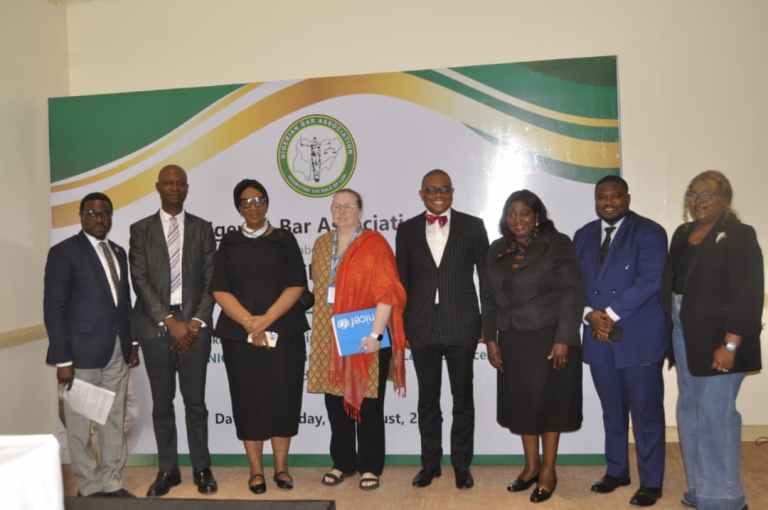
The Nigerian Bar Association (NBA) and UNICEF have launched a nationwide partnership to provide free legal representation to children, warning that vulnerable children without access to lawyers risk turning legal challenges into lifelong disadvantages.
The initiative, unveiled in Abuja on Monday, will mobilise lawyers across Nigeria to provide pro bono services to children, strengthen collaboration between courts and child-protection agencies, and equip legal practitioners with the skills required to handle children’s cases differently from those involving adults.
NBA President, Mazi Afam Osigwe, SAN, said the absence of legal representation for a child who cannot afford a lawyer represents more than a gap in service, describing it as a failure of the justice system.
“Access to justice is not a privilege. It is the fundamental right of every child,” Osigwe said.
He urged NBA branches to establish child-focused pro bono schemes, called on law firms to dedicate time to child-protection cases, and encouraged Senior Advocates to mentor younger lawyers in child-sensitive legal practice.
Delivering a message on behalf of the Attorney-General of the Federation, stakeholders stressed the need for a justice system that recognises children’s age, vulnerability and right to rehabilitation.
UNICEF Country Representative, Wafaa Saeed, said children within Nigeria’s justice system continue to face detention without legal representation, prolonged delays, weak referral systems and limited access to diversion and support services.
“Access to justice is not simply a legal issue. It is a child protection issue, a development issue, and a matter of human dignity,” Saeed said.
UNICEF’s national assessment of children deprived of liberty found that many minors spend months in detention over minor offences because there is no one to advocate for bail, diversion or alternative care. In some instances, the intervention of a single lawyer resulted in a child’s release, family reunification and return to school.
Speakers, including Garki NBA Chairman, Alkali Askira, also expressed concern over children being transferred far from their parents and communities to face trial, as well as the practice of labeling children as “criminals” before a court determines their guilt.
An accused child, stakeholders noted, remains entitled to due process, adding that poverty or the inability to secure legal representation should not deprive any child of that right.
The partners stressed that lawyers alone cannot reform the system, identifying the judiciary, police, correctional services, Legal Aid Council, civil society organisations, government agencies and communities as critical stakeholders.
UNICEF’s 2025 data indicates that two out of every three Nigerian children live in multidimensional poverty, a situation that increases their vulnerability to contact with the justice system without adequate support.
Under the partnership, the NBA and UNICEF will expand pro bono legal services for children nationwide, build lawyers’ capacity in child-friendly justice, improve referral pathways between courts and child-protection actors, and support diversion and rehabilitation for children in conflict with the law.
For Osigwe, pro bono services must move from “ceremony to action.”
Stakeholders said the real measure of the partnership would not be the discussions held in Abuja conference rooms, but the impact seen in police stations and courts—particularly whether a child can secure legal representation before spending months in detention.