
Politics
Peter Obi officially kicks off his 2027 presidential campaign, promising to reset Nigeria through unity, security and production.

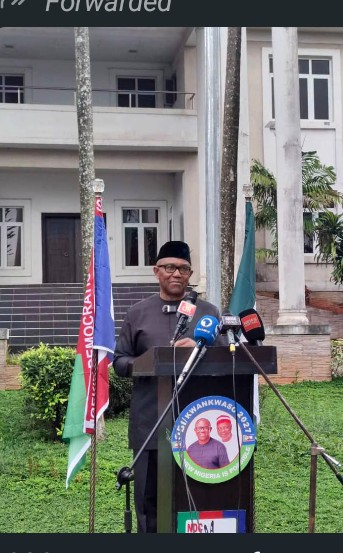
Presidential candidate Peter Obi has formally commenced his campaign for the 2027 presidential and National Assembly elections, declaring that Nigeria can and must work despite the numerous challenges confronting the country.
In an address to Nigerians, members of the press and other stakeholders on Friday, August 21, Obi described the 2027 election as a defining moment for Nigeria’s democracy, urging citizens to carefully examine the records, ideas and plans of all candidates seeking their mandate.
Obi said he was privileged to be among those seeking to lead the country, stressing that his campaign would be guided by the conviction that “Nigeria can work, and Nigeria must work.”
He highlighted poverty, food insecurity, internal displacement, unemployment, insecurity, poor infrastructure, unreliable electricity and the high cost of doing business as some of the major challenges facing Nigerians.
According to him, these challenges go beyond statistics because they reflect the daily realities of families, farmers, workers, students and businesses across the country.
Obi, however, maintained that Nigeria has the people, resources, talent, market and enterprise needed to overcome its challenges, saying the priority should be to transform these strengths into security, productivity and shared prosperity.
Leadership Must Deliver Results
The former Anambra State governor said his experience in the private sector, studies in policy and business, and service as governor had shaped his understanding of public leadership.
He said government must manage resources responsibly, establish clear priorities and measure the outcomes of its decisions, stressing that public office should be regarded as a responsibility to the people rather than a reward.
Obi said his administration in Anambra prioritised education, healthcare, infrastructure, fiscal discipline and institutional capacity, while acknowledging that the record was not perfect and should be assessed by Nigerians.
He also referenced Senator Rabiu Musa Kwankwaso’s experience as governor of Kano State, particularly his administration’s emphasis on education, technical training, scholarships, infrastructure and human-capital development.
According to Obi, although their experiences are different, they share the conclusion that Nigeria must invest in its people and manage public resources with discipline.
Building an Economy That Works
Obi said Nigeria needs more than reactive reforms, arguing that government must focus on whether Nigerians are better off, whether they can afford food, education and healthcare, and whether businesses can produce, expand and create jobs.
He said his economic agenda would place production, investment, enterprise and human capital at the centre of governance.
He promised to improve agricultural productivity by securing farming communities, expanding irrigation, improving rural roads and storage, and connecting farmers to finance and markets.
He also pledged to strengthen manufacturing and agro-processing to enable Nigeria to export more finished products and derive greater value from its resources.
Obi said his administration would create a business environment where entrepreneurs could invest, employ workers and expand without unnecessary regulatory or infrastructure barriers.
He also promised responsible management of public finances, insisting that every naira must have a clear purpose and major public investments must produce measurable outcomes.
Security as the Foundation
The presidential hopeful described security as the foundation for national prosperity, noting that insecurity has displaced millions of Nigerians and disrupted agriculture, education, trade and investment.
He proposed improved intelligence gathering and coordination among security agencies, stronger policing and border management, greater use of technology and support for lawful community-based systems capable of identifying threats early.
Obi also stressed the importance of decentralising security management while maintaining strong coordination among different levels of government.
He said security policy must address the conditions that make vulnerable young people susceptible to criminal recruitment, adding that farmers, students and businesses cannot thrive when their safety is threatened.
From Consumption to Production
Obi said Nigeria’s population of more than 200 million people represents a major economic opportunity, particularly because of the country’s large domestic market and labour force.
He argued that Nigeria cannot import its way to prosperity, stressing the need to produce more of what the country consumes, process more of what it produces and compete more effectively in global markets.
According to him, agriculture, manufacturing, technology, construction, energy, creative industries and services all have important roles to play in transforming Nigeria’s economy.
Young Nigerians and Healthcare
Obi described Nigeria’s young population as the country’s greatest asset rather than a burden.
He pledged to improve basic education, strengthen universities and expand technical and vocational training to prepare young Nigerians for productive participation in the economy.
He also identified healthcare as an important component of human capital, promising to strengthen primary healthcare, improve maternal and child health, expand access to essential medicines and equip healthcare workers.
Regional Development
Obi said Nigeria’s diversity should be treated as an economic strength, with every region given the opportunity to develop its distinct resources while being connected to a productive national economy.
He outlined development priorities for the North-West, North-East, North-Central, South-West, South-East, South-South and Federal Capital Territory, covering areas including agriculture, manufacturing, technology, education, infrastructure, trade, energy, maritime services, housing, transportation and public services.
He declared: “Every region must produce. Every region must contribute. Every region must benefit.”
A Different Standard of Governance
Obi said sustainable development requires more than reactive reforms, insisting that the ultimate goal of governance must be better lives for Nigerians.
He pledged to cut wasteful spending while protecting investments that create jobs and expand productive capacity.
He also promised to increase public revenue without stifling businesses and invest in education, healthcare, security and infrastructure.
According to him, institutions must be built to endure beyond any single administration, adding that this should be the standard by which every government is judged.
Obi urged Nigerians to examine the records and proposals of all candidates, ask difficult questions and demand evidence behind their promises.
He called for issue-based campaigns, urging politicians to debate ideas without hatred, compete without violence and disagree without weakening the bonds that unite Nigerians.
Call for Direct Engagement
The former Anambra governor said presidential candidates should be willing to travel across the country, meet Nigerians, answer their questions and defend their records and visions.
He criticised the use of proxies and surrogates during campaigns, arguing that true leadership requires presence and empathy.
Obi said no one could effectively lead communities affected by banditry, terrorism, criminality and flooding without visiting, listening to and understanding those communities.
He pledged that he and his running mate would take their message directly to Nigerians, listen to their concerns and openly defend their record, character and plans for the country.
He said the 2027 election should be guided by capacity, competence, compassion, character and commitment, rather than ethnicity, religion, elitism, cronyism or propaganda.
Obi said his campaign would focus on uniting Nigeria, defeating insecurity, reducing poverty and hunger, tackling the number of out-of-school children, improving education and healthcare, and building an economy that serves all Nigerians, particularly the most vulnerable.
He concluded by declaring his commitment to “resetting Nigeria” by uniting the country, securing it, pursuing inclusive economic growth and moving Nigeria from consumption to production.
“A New Nigeria is possible,” Obi declared.