
General News
Academic excellence gets a major boost as FG unveils National Laureate Programme.

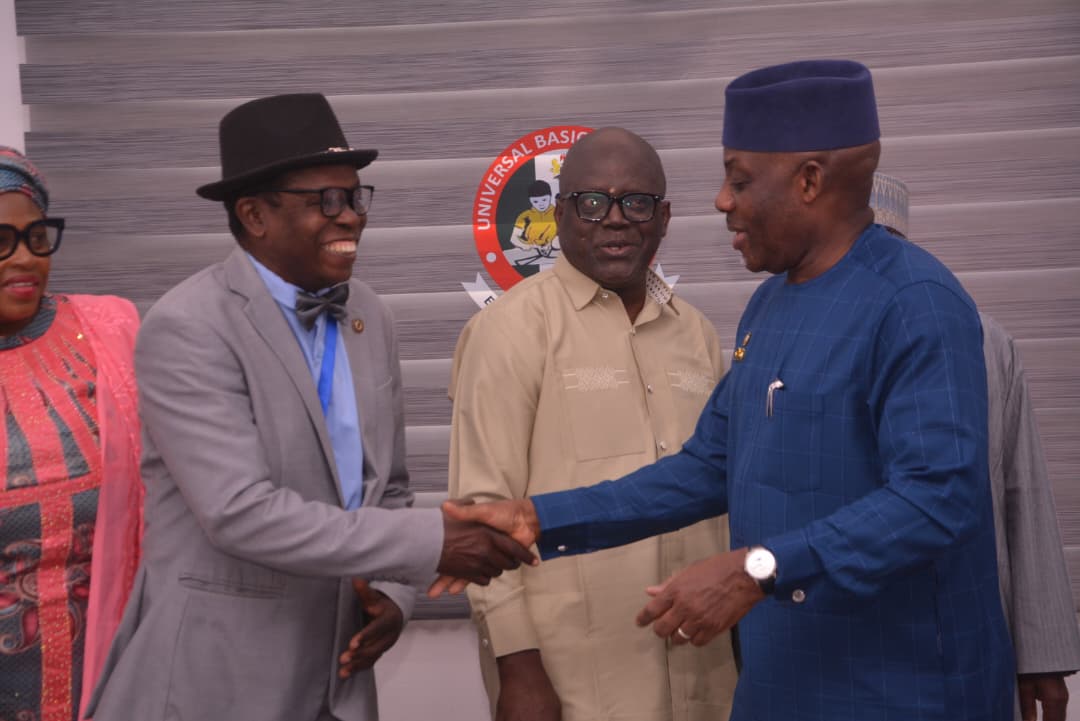
The Federal Government has inaugurated the Tertiary Institutions National Laureate Committee and unveiled an annual research award programme worth approximately ₦365 million to reward outstanding undergraduate, master’s and doctoral research across Nigeria.
The Committee was inaugurated by the Minister of Education, Tunji Alausa, at the Digital Resource Centre of the Universal Basic Education Commission (UBEC). It will oversee the implementation of the National Laureate Programme, a flagship initiative aimed at promoting academic excellence, research commercialisation and innovation across accredited post-secondary and tertiary institutions in Nigeria.
Speaking at the inauguration, Dr. Alausa said the programme reflects the Federal Government’s commitment to reshaping the country’s reward system by placing scholarly achievement, scientific discovery and innovation alongside other nationally celebrated accomplishments.
According to the Minister, the initiative is designed to inspire a new generation of Nigerians to pursue research capable of solving real-world challenges, creating new industries and strengthening the country’s global competitiveness.
He noted that the future prosperity of nations depends on their ability to convert knowledge into economic value, stressing that Nigeria must deliberately celebrate intellectual achievement to build a globally competitive knowledge economy.
Dr. Alausa added that in an era dominated by the social media-driven attention economy, the Federal Government considers it necessary to establish a national platform that rewards creativity, scholarship, invention and commercially valuable research, particularly among young people.
The Committee is chaired by Emeritus Professor Abubakar Sambo and includes Professor Solomon Nwhator, Professor Tolulope Ariyomo, Professor Francis F. Uba, Dr. Babangida Abubakar Albaba, Dr. Salihu Bakari Girei, Professor Carol Arinze-Umobi, Dr. Obianuju Anigbogu, Mr. Francis Egbokare, Dr. Ezinne Orisakwe and Dr. Pius O. Ekireghwo. Mr. Richard Falaye, Secretary of the Nigeria Education Repository and Databank (NERD), will serve as Secretary to the Committee.
The inaugural National Laureate Awards are scheduled for November 2026 and will recognise the country’s best Undergraduate Dissertations, Master’s Theses and Doctoral (PhD) Theses, alongside six thematic Excellence Awards covering Medicine and Health Sciences, Engineering and Technology, Agriculture, Law, Arts and Social Sciences, and Teaching Innovation.
Under the approved prize structure, the best Undergraduate Dissertation will receive ₦35 million, the best Master’s Thesis ₦50 million, while the overall Doctoral (PhD) winner will receive ₦100 million.
In addition, six National Laureate Excellence Awards valued at ₦30 million each will be presented annually, bringing the programme’s total prize pool to about ₦365 million.
The Minister also announced the establishment of the Dr Stella Adadevoh Excellence Award in Medicine and Medical Innovation, created in honour of Stella Adadevoh for her leadership during the 2014 Ebola outbreak, which helped prevent a nationwide public health crisis.
Dr. Alausa directed the Committee to conclude work on eligibility requirements, evaluation procedures and institutional engagement ahead of the inaugural awards in November.
He also commended Engr. Olatunji Ariyomo, Chairman of NERD, for his contributions to transformative interventions in Nigeria’s education sector.
Responding on behalf of the Committee, Chairman Emeritus Professor Abubakar Sambo described the initiative as a landmark in Nigeria’s education policy and praised the administration of Bola Ahmed Tinubu for placing academic excellence and research at the centre of national development.
Professor Sambo pledged that the Committee would uphold transparency, fairness and merit throughout the selection process. He also assured the Minister that every eligible student, regardless of institution or geographical location, would have an equal opportunity to attain National Laureate status without institutional bias or undue influence.
Education analysts believe the National Laureate Programme could become one of the most significant reforms in Nigeria’s tertiary education sector if successfully implemented. Beyond its substantial prize fund, they say the initiative signals a shift in national priorities by recognising ideas, discoveries and innovations capable of driving economic transformation.
The programme is also expected to strengthen collaboration among universities, polytechnics, colleges of education, industry and government, encourage commercially viable research and enhance Nigeria’s competitiveness in the global knowledge economy.