
General News
Tabiowo’s Book Sheds Light on National Assembly

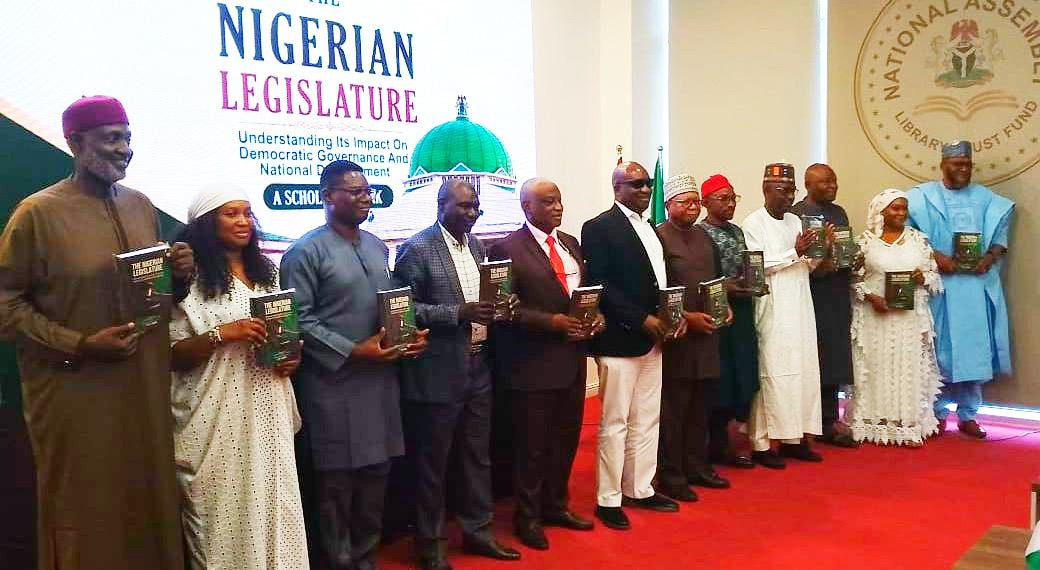
A new book titled The Nigerian Legislature: Understanding its Impact on Democratic Governance and National Development has been described as a major scholarly work that offers a detailed examination of Nigeria’s parliamentary evolution, constitutional responsibilities and the National Assembly’s role in strengthening democratic governance.
Written by Dr. Ezrel Tabiowo, the publication provides an extensive analysis of legislative practice in Nigeria, focusing on the budget process, the consideration of executive requests for domestic and external borrowing, and the National Assembly’s oversight responsibilities over the executive arm of government.
Reviewing the book, former Senator and Nigerian Ambassador to Germany, Ita Enang, said it chronicles how constitutional responsibilities were discharged under former Senate Presidents Evans Enwerem, Chuba Okadigbo and Anyim Pius Anyim, as well as former House of Representatives Speakers Salisu Buhari, Ghali Umar Na’Abba, Aminu Bello Masari, Patricia Etteh and Dimeji Bankole during the Fourth, Fifth and Sixth National Assemblies. He noted that the publication also examines the legislature’s scrutiny of executive nominations for ministerial, ambassadorial, constitutional and other strategic appointments, stressing that Senate confirmation is a constitutional responsibility that demands diligence, objectivity and independent judgment.
According to Enang, the book explores the relationship between the legislature and the media, explaining how media reports have shaped public perception of parliamentary activities. It also provides context for controversial legislative decisions, with the aim of improving public understanding of parliamentary procedures, strengthening confidence in the legislature and encouraging informed participation by civil society organisations, advocacy groups and citizens.
The publication pays tribute to former Senate President Ahmed Lawan for his mentorship and commitment to strengthening Nigeria’s democratic institutions during his 27 years of uninterrupted service in the National Assembly. It also acknowledges the National Assembly for providing the institutional environment that enabled the author to document significant legislative developments over the years.
Enang described the book as the product of extensive research, combining constitutional and statutory analysis, comparative legislative studies and the author’s experience as a parliamentary correspondent and media adviser. He said the book traces the evolution of legislative institutions from pre-colonial governance through the colonial era, the Westminster parliamentary system, military rule and the current presidential system, arguing that these historical developments continue to shape Nigeria’s legislature.
The publication also examines legislative oversight and accountability, highlighting institutional strengths and weaknesses through case studies of major investigations. It further analyses economic governance, including the appropriation process, constituency projects, fiscal federalism and legislative contributions to policy development in sectors such as education and infrastructure.
The book discusses key challenges facing the National Assembly, including institutional capacity gaps, high legislative turnover, ethical concerns, executive-legislative relations, judicial interventions and socio-economic factors. It also assesses the impact of globalisation, digital technology and social media on legislative practice and public engagement while proposing reforms to strengthen democratic institutions, enhance accountability and improve legislative effectiveness.
Director-General of the National Institute for Legislative and Democratic Studies (NILDS), Prof. Abubakar Sulaiman, described the publication as an important addition to knowledge on Nigeria’s legislature, citing the author’s vast experience in the legislative space. He said the book would serve as a valuable resource for lawmakers, researchers, students and anyone seeking a deeper understanding of democracy and governance, recommending it for all NILDS students and departments.
Clerk to the National Assembly, Barrister Kamorudeen Ogunlana, commended Dr. Ezrel Tabiowo, who served as Media Adviser to the President of the 9th Senate, saying the book would help correct public misconceptions about the workings of the National Assembly.